Carousels with AI in 10 minutes: why some get swiped to the end and others don't
A good carousel isn't "a post sliced into slides." It's the slippery-slide method and six elements baked in. One of mine hit 180k views.
01 — The trap
Why doesn't "a post sliced into slides" land?
Everyone loves watching carousels, nobody loves making them — me included, honestly. And it seems easy: take a post, slice it into parts, slap a headline on the first slide, add "save this, it'll come in handy" at the end — ready to go viral.
It doesn't work that way. Slicing gives you a set of slides, not a carousel. The difference is the same as between a list of facts and a story: the first gets scrolled past, the second gets watched to the end. For a carousel to be swiped through and saved, a mechanic has to work inside it — not just a headline sitting on an image.
Slide 3: "AI saves time on routine." Read it, nodded, swiped on — nothing more to say.
Slide 3: "But there's one type of task where AI makes things worse. And you're probably doing it right now"
02 — The slippery slide
What is the slippery-slide method?
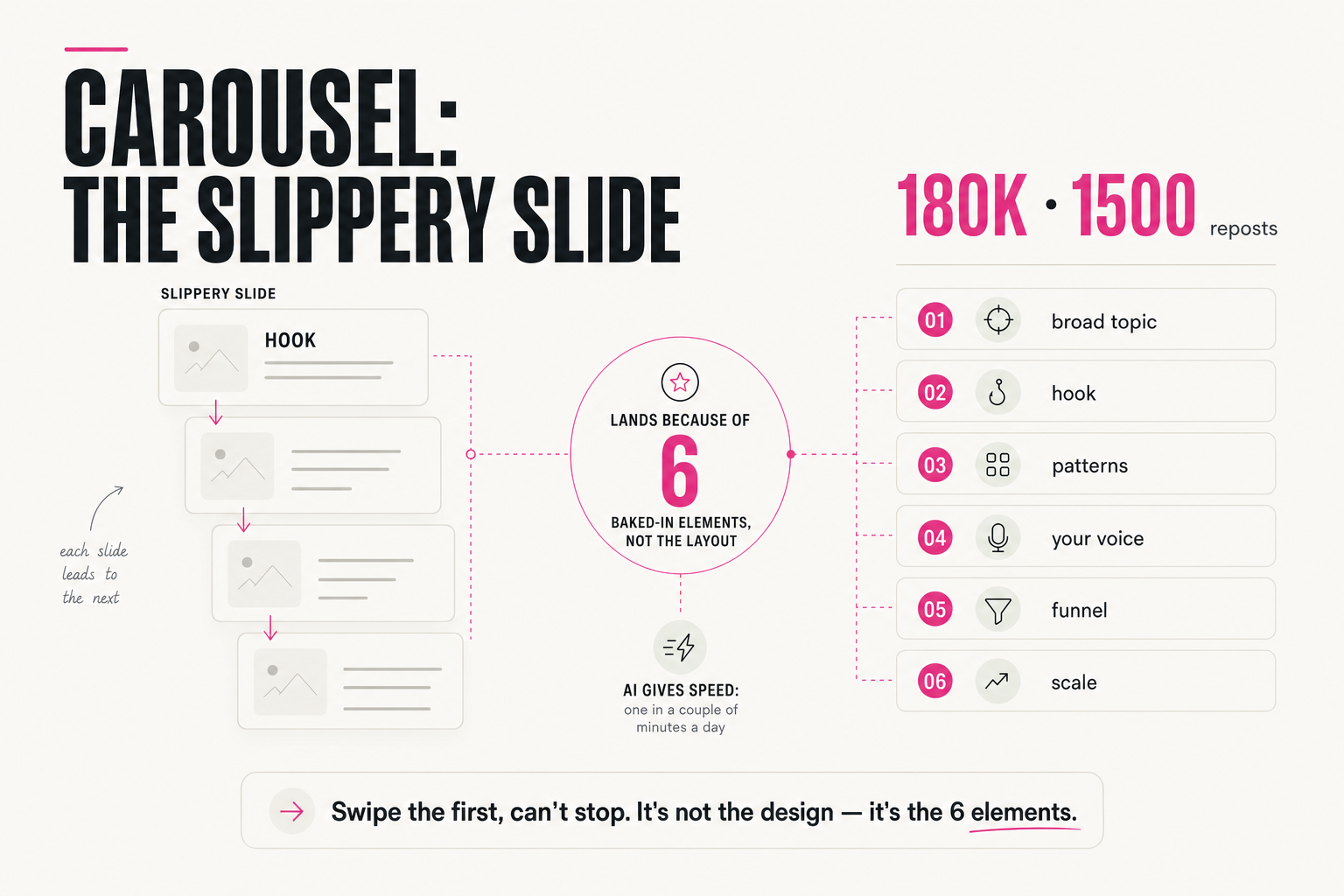
A good carousel is text built on the slippery-slide method. You swipe the first slide — and you can't stop. Each slide leads forward, logically and emotionally, to the next. And there you are at the end: saving it, sending it to a friend, thinking "damn, this is about me."
You swipe the first slide and can't stop. Each one pulls you to the next. That's the slippery slide.— Anjela Petkova
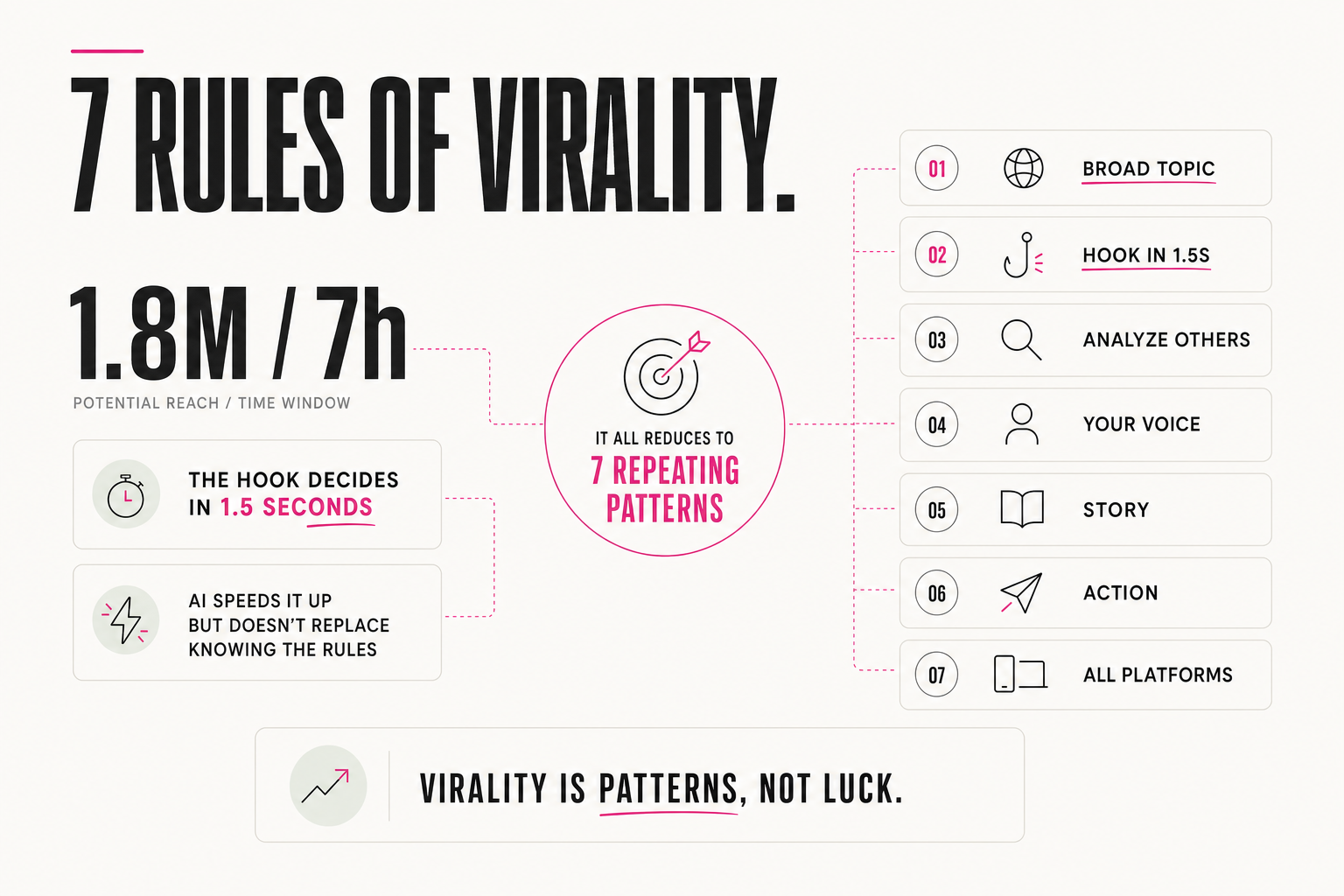
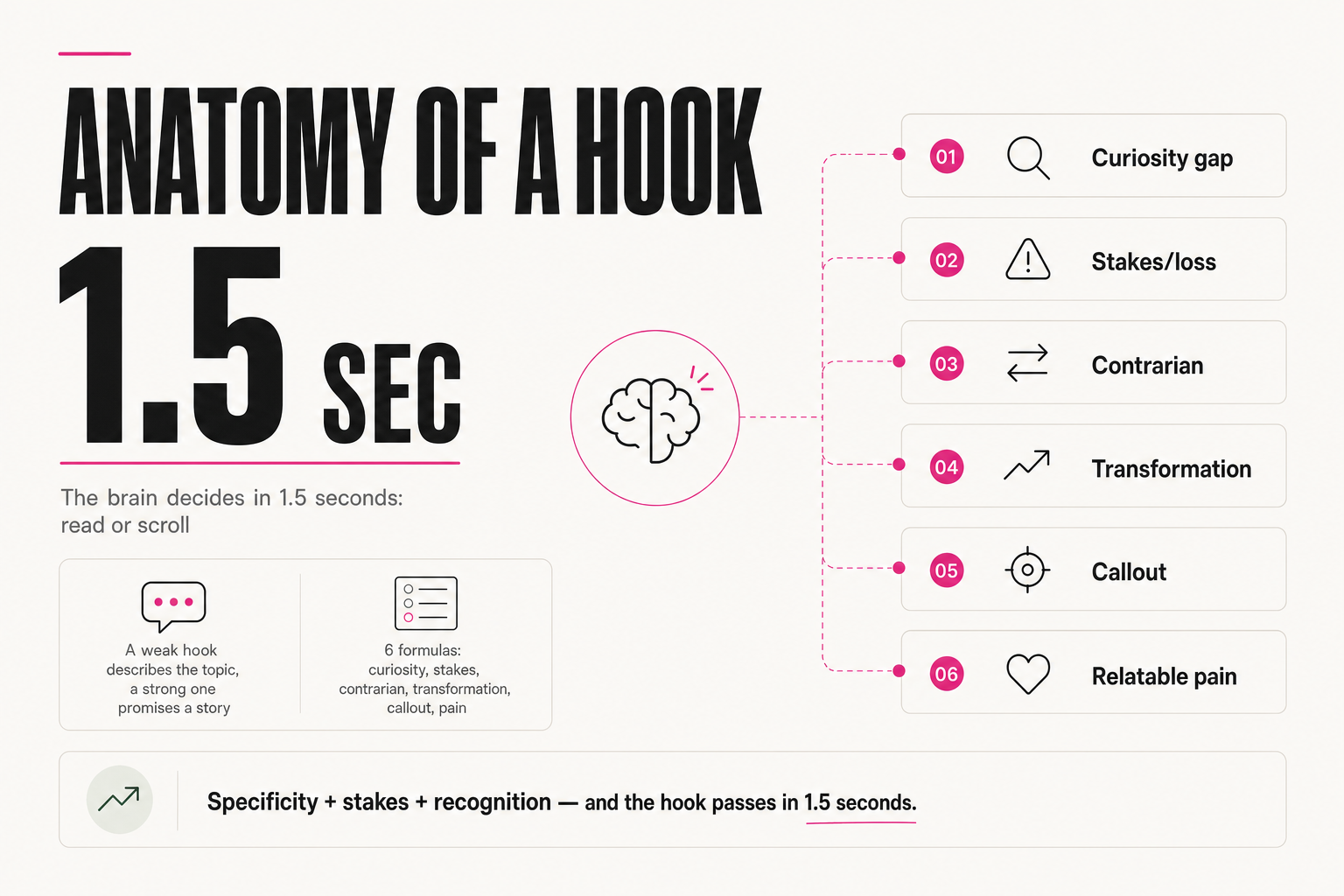
In practice that means: the first slide is a hook (like in any viral post, it decides in 1.5 seconds), and each next one cuts off on a thought you want to finish. Not "slide = fact," but "slide = a step you can't help taking."
Slide 1 (hook): "I spent 2 hours on a prompt — for something
                I could've gotten in 5 minutes"
Slide 2:        "The problem wasn't the prompt. The problem was
                I shouldn't have been doing this myself at all"
Slide 3:        "Here are 3 signs a task isn't for you — it's for AI:"
03 — Six elements
Why does a carousel land — and why isn't it the design?
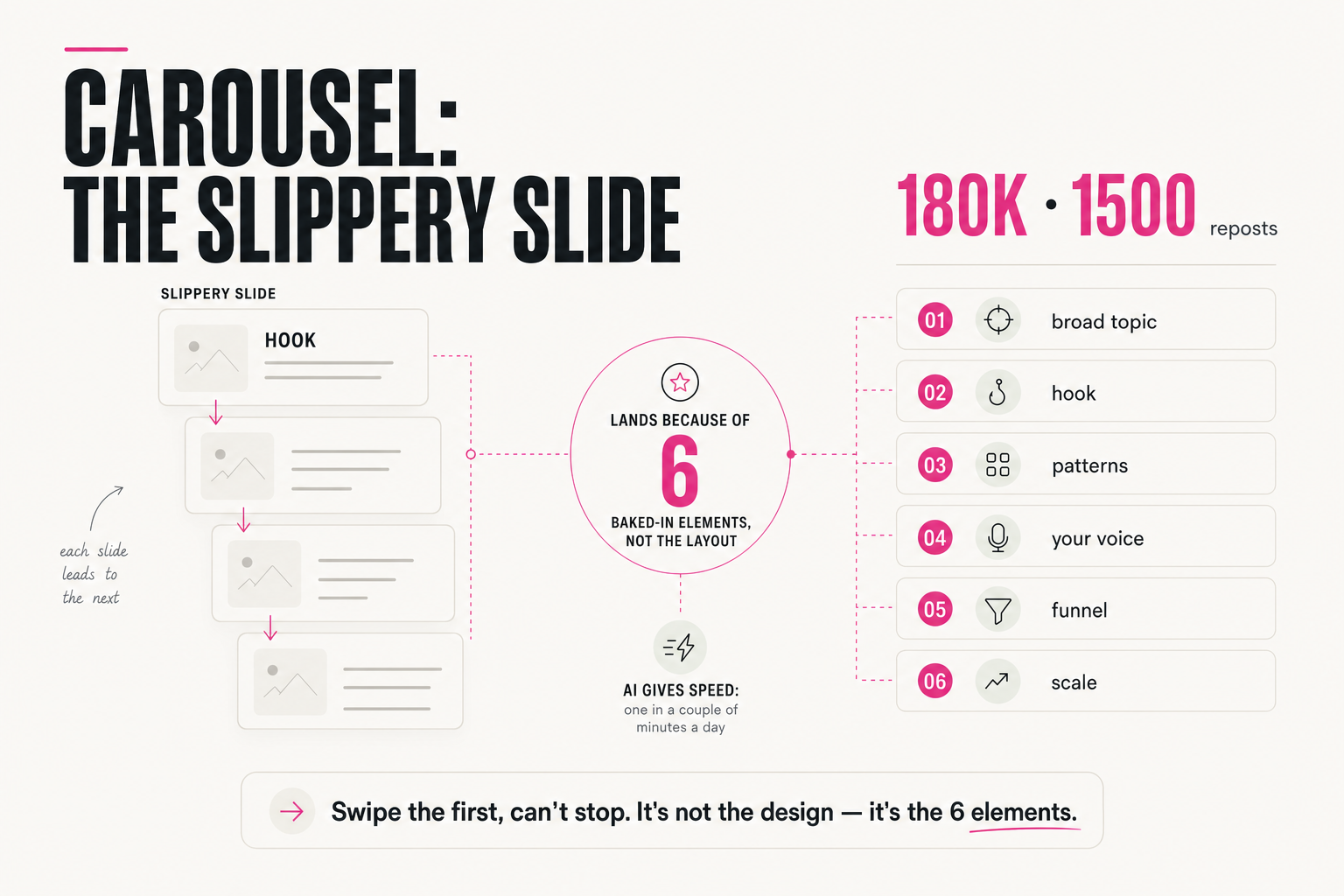
One of my carousels hit 180k views, 1500+ reposts and over 400 people entering the funnel — and ChatGPT built and laid it out in a couple of minutes. It's not about "elaborate design." It's about the elements baked inside:
1. A broad topic (a mass recognizes it, not a narrow segment)
2. A hook on the first slide
3. Patterns from analyzing others' viral content
4. Your own delivery — unpacked sub-personas, your voice
5. A funnel: push to Telegram, opt-in, a comment
6. Scale across platforms (Threads, Instagram, carousel)
You can make three "elaborate" carousels a month that may or may not land. Or you can build one in a couple of minutes a day — and they land, because those six things work inside.
04 — AI's role
How do you build a carousel with AI in 10 minutes?
A carousel's content always depends on context — and there are two paths. You can drop in a finished post and ask it to package it into a slippery slide. Or you can write from scratch, but with context: who the audience is, what tone, what goal, what effect you need at the end.
The second path is stronger, because you tell the model not "slice it" but "build it so they keep swiping." Best to keep that prompt in a project or assistant — then the context (your audience, voice, goal) doesn't need re-explaining every time, and the carousels come out consistently in your style, not average.
Here's my post/idea: [paste it].
Audience: [who reads it]. Tone: [your style].
Goal: to be swiped to the end and saved.
Build it on the slippery-slide method: slide 1 is a hook, each
next one cuts off on a thought you want to finish.
Don't retell facts one by one — lead into the next slide.
05 — Rhythm
Why does speed beat "fuss"?
AI's main advantage here isn't "prettier," it's "faster and more regular." When a carousel comes together in a couple of minutes, you can post one every workday. Whoever "fusses" will post three a month — and each might still not land.
3 carousels a month, hours each, no guarantee they land.
A carousel in a couple of minutes every workday — more shots, more hits.
Virality is a game of volume of attempts on a proven structure. AI gives the volume; the slippery slide and the six elements give the structure.
06 — Visuals
And what about the visual design?
Slippery-slide text is half the job; the other half is making the carousel impossible to scroll past in the feed. Visuals decide whether the thumb stops; the text decides whether it's watched. AI handles the layout too: you can ask it to lay out the slides and match a style to your references.
To keep visuals consistently yours rather than random, build the layout not from scratch each time but from a brand style — like any other material. There's a full breakdown in a separate piece, "Design with AI": brand book, multi-model testing and on-style images.
Here's the carousel text, slide by slide: [paste it].
Lay it out in this style: [palette/typography/references from
your brand style]. One visual accent per slide, no more.
The hook on slide 1 — bigger and higher-contrast than the rest,
so the thumb stops.A carousel lands not because of design but because of the slippery slide and six baked-in elements. AI gives speed and a volume of attempts; you set the structure, voice and funnel. One in a couple of minutes a day beats three "elaborate" ones a month.
FAQ
Why don't my carousels get swiped to the end?
Most often because it's a sliced post, not a slippery slide. If a slide is just a fact, it gets scrolled past. The first slide needs to be a hook, and each next one needs to cut off on a thought you want to finish — then the person watches to the end and saves it.
Isn't it about beautiful design, though?
Design helps stop the thumb, but a carousel lands because of baked-in elements: a broad topic, a hook, virality patterns, your own delivery, a funnel and scaling across platforms. A 180k carousel was built by ChatGPT in a couple of minutes — not from "elaborate" design but from those six things.
How do you build a carousel with AI in 10 minutes?
Two paths: drop in a finished post and ask it to package it as a slippery slide, or write from scratch with context — audience, tone, goal, the effect you want. The second is stronger. Keep the prompt in a project or assistant so you don't re-explain context each time and get carousels in your style.
Better to fuss over one or post often?
Often. Virality is a game of volume of attempts on a proven structure. One carousel in a couple of minutes every workday lands more than three "elaborate" ones a month, each of which might still flop. AI gives exactly that volume without losing quality.