Anatomy of a hook: the first line decides if they read you or scroll
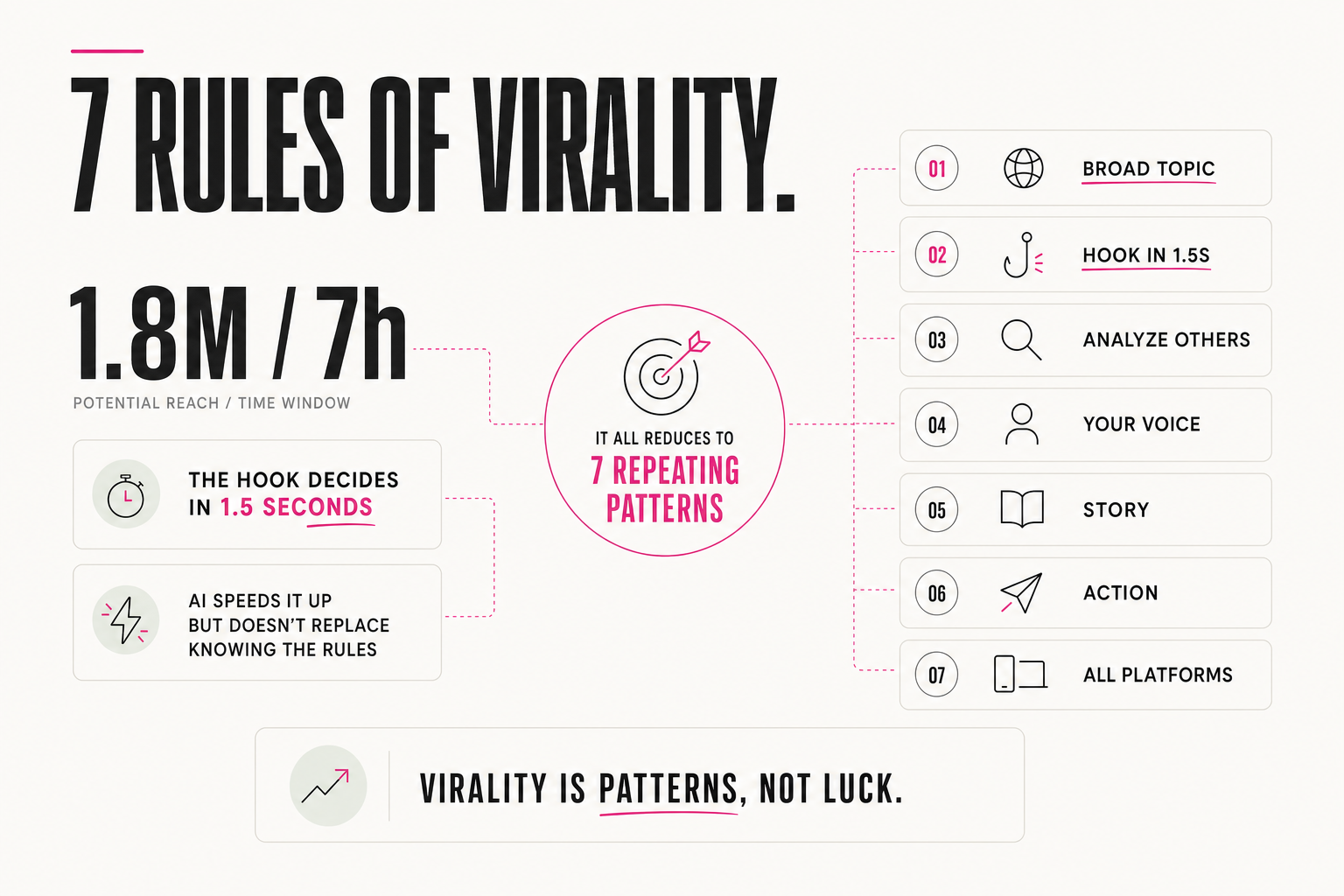
The brain gives your post 1.5 seconds. Six hook formulas that pass the test, and how AI drafts them by the dozen in minutes.
01 — The entry ticket
Why does the first line decide everything?
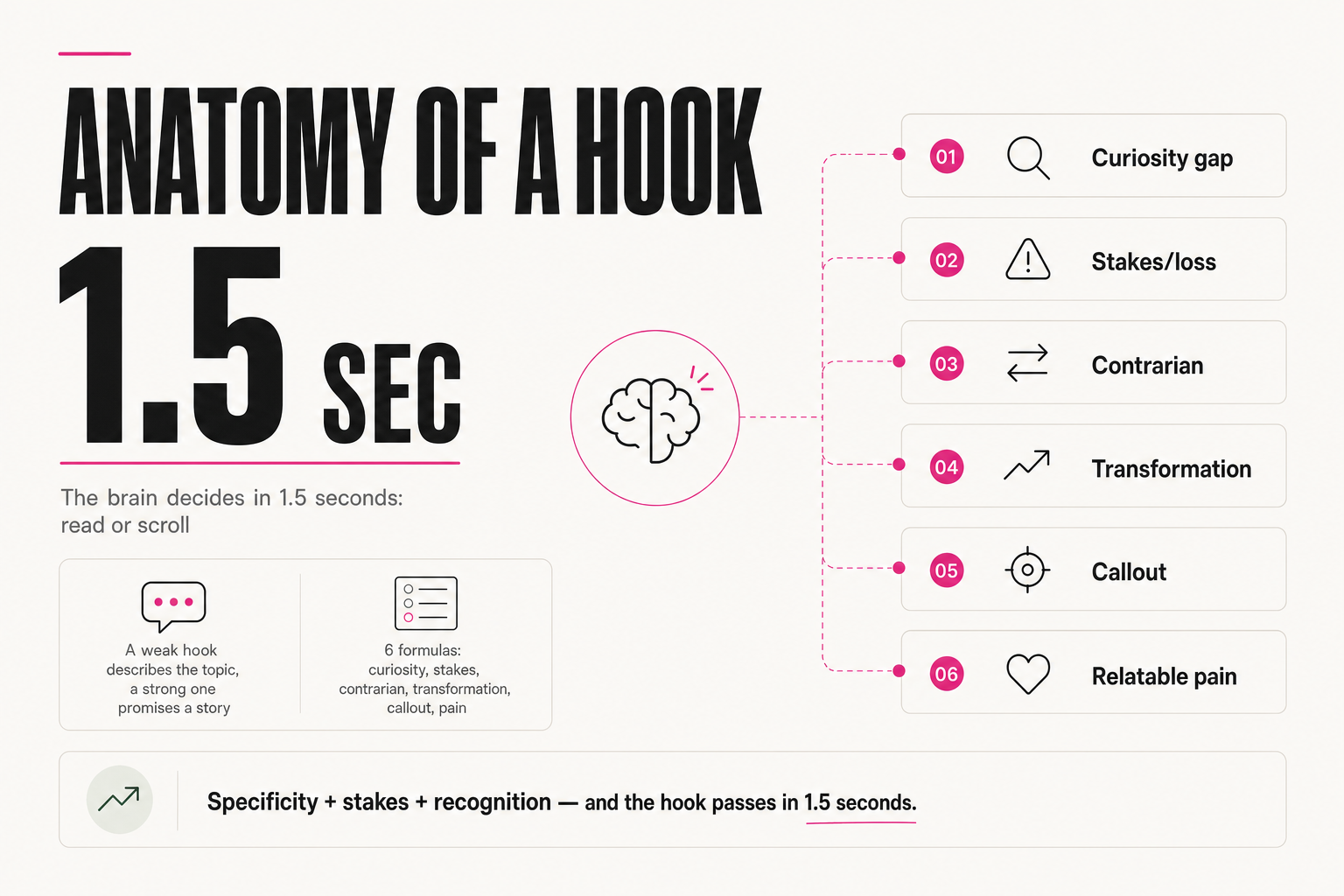
A feed has hundreds of posts; yours is one of them. The brain decides in about 1.5 seconds: "is this about me or not?" If the first line gives no clear signal, they scroll on — and all your work below the hook goes unseen.
So a hook isn't an "intro" or decoration — it's the entrance. You can write a brilliant post and lose it on the first line. And vice versa: a strong hook lifts the same idea from 500 views to tens of thousands. All the work on the text starts with whether it survives those 1.5 seconds.
Read only the first line out loud and ask:
1) Would I stop scrolling after this line?
2) Is there a concrete detail, number or stake — or just a topic?
3) Would a random person in my niche see themselves in it?
2+ "no"s? Rewrite the line using one of the formulas in section 03.
02 — What a hook isn't
Why does "today I'll talk about…" kill a post?
A weak hook describes the topic. It politely announces what's coming — and that's exactly why it loses: the brain has nothing to grab, no stake, no tension, no "this is about me."
"Today I'll talk about delegation"
"Let me share how I budget"
"I lost $2,500 because I was afraid to delegate"
"I earned well and lived in debt. Here's what I changed"
The difference is three things: specificity, stakes and recognition. A hook doesn't announce a topic — it creates a promise and a tension you want to resolve by reading.
03 — Six formulas
Which hook formulas repeat across viral posts?
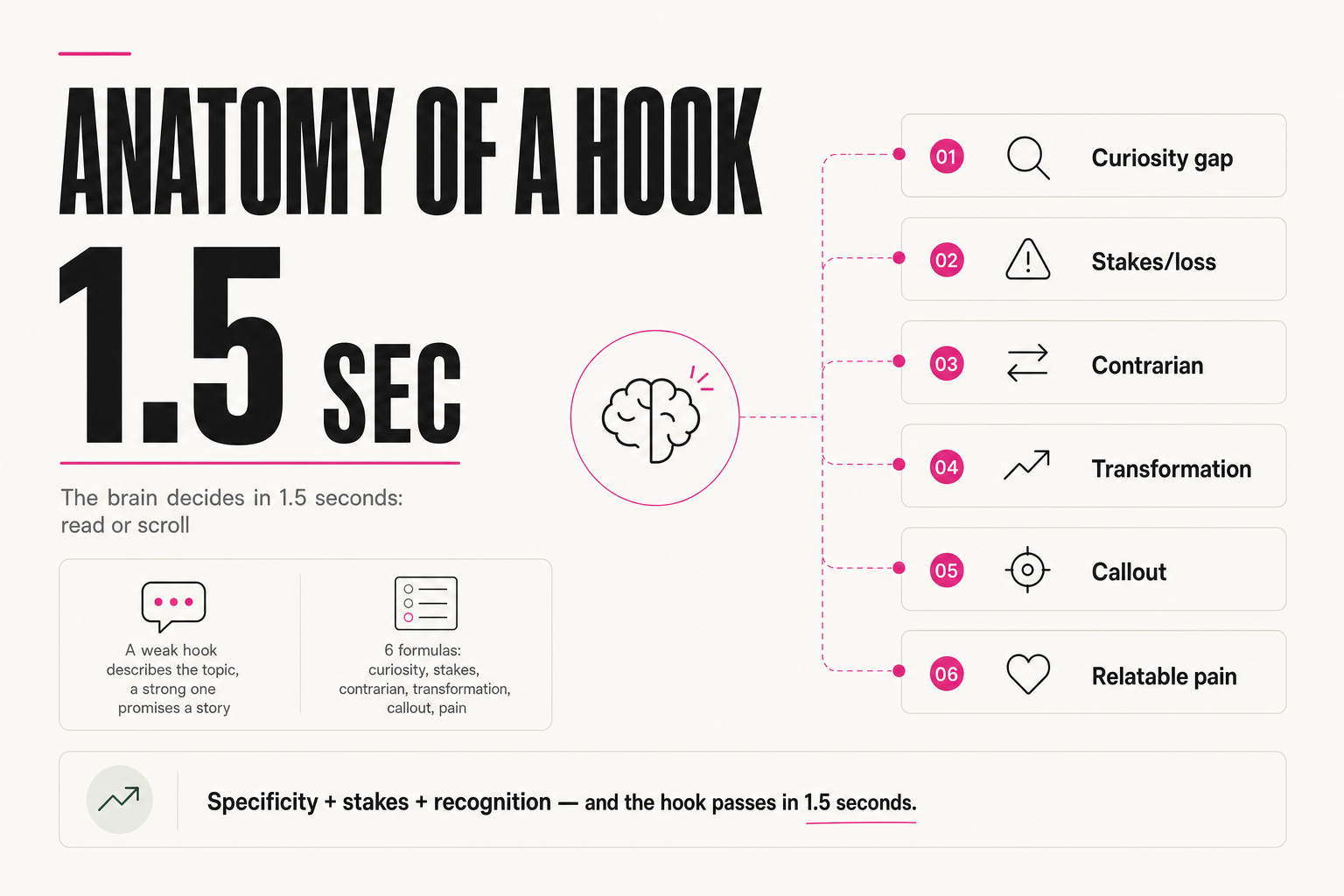
Break down hundreds of posts that landed and you see a few repeating formulas. Here are six that work:
1. Curiosity gap:   "I trained ChatGPT and got so productive it felt illegal"
2. Stakes / loss:   "She lost her business before it even started — and learned one thing"
3. Contrarian:      "Never do business with friends"
4. Transformation:  "My business 2 years ago → and now"
5. Direct callout:  "Are you actually making money from your business?"
6. Relatable pain:  "You start a business — nobody told you you'd have to
                     become a content creator too"
Each hits a different trigger: curiosity, fear of loss, disagreement, the dream of a result, a direct "this is me," recognition of your own pain. For any topic, at least one fits.
04 — AI's role
How does AI help with hooks — and where does it fall short?
AI is an accelerator here: it spins one idea into 20 hook variants across the different formulas in a couple of minutes — which kills the blank-page fear and gives you something to choose from.
But there's a line. The model returns strong and empty variants mixed together, and if you don't know the criteria you'll take the "pretty, smooth" one instead of the gripping one. So the combo is: AI generates quantity, you select by the rule "is there specificity, stakes and recognition here." Without that filter, AI just produces weak hooks faster.
Here's my post topic/idea: [describe it].
Generate 20 first-line variants, 3-4 for each formula: curiosity
gap, stakes/loss, contrarian, transformation, direct callout,
relatable pain.
For each one, name which formula it uses.
05 — For your niche
How do you adapt the formulas to your topic?
The formula is the frame; the filling is yours. Take your topic and run it through each of the six formulas, widening to a universal pain (narrow "B2B SaaS negotiation techniques" → broad "what to do when they say it's expensive").
And do what most people skip: break down 15–20 viral posts in your niche. Which formulas repeat there, what your specific people react to. That turns the hook from a lottery into a skill: you're not guessing, you're assembling from patterns proven in your niche.
Narrow (expert) topic: [fill in yours].
Ask: would anyone outside my niche see themselves in this?
If not, widen it: "B2B SaaS negotiation techniques" →
"what to do when they say it's expensive" — now it's about everyone.
Now apply one of the 6 formulas to the wide version.
06 — Where to start
How do you start writing strong hooks today?
Take your last weak post and rewrite only the first line — through three of the six formulas. Run 10 more variants through AI, select by the filter "specificity + stakes + recognition."
1. Find a post of yours with low reach
2. Keep the topic, delete the first line
3. Rewrite it using the "stakes/loss" and "direct callout" formulas
4. Run both through the filter from section 04
5. Publish with the new hook, save both variants to compareA hook is the entrance, not the intro. Don't describe the topic — promise a story with stakes the reader sees themselves in. There are only a few formulas; AI gives quantity, criteria give the hit.
FAQ
How much time does a hook really have?
About 1.5 seconds — that's how long the brain takes to decide "is this about me or not" while scrolling. In that window the decision is emotional, not logical. If the first line gives no clear signal and grab, the rest of the post goes unread, however good it is.
What separates a strong hook from a weak one?
A weak one describes the topic ("today I'll talk about…"); a strong one promises a story with stakes and recognition. The difference is three things: specificity (a number, a detail), stakes (what's on the line) and "this is about me." A hook doesn't announce — it creates a tension you want to resolve by reading.
Can AI invent hooks for me?
AI is great at quantity — 20 variants of one idea across formulas in minutes. But it returns strong and empty ones mixed together, and without criteria you'll pick the "pretty" one, not the gripping one. Use AI for quantity and select yourself by the filter: specificity, stakes, recognition.
Do the formulas work in a boring niche?
Yes, if you widen the topic to a universal pain. "B2B SaaS negotiation techniques" → "what to do when they say it's expensive." First lift the topic to something a mass of people see themselves in, then apply the hook formula — and break down viral posts specifically in your niche.