"I'm out of content ideas" is a myth. Here's the infinite source
Why "give me 50 topics" returns templated junk — and a two-source system that produces ideas faster than you can publish.

01 — The trap
Why does "give me 50 topics" return templated junk?
You sit there not knowing what to write. You ask "ChatGPT, give me 50 topics about marketing" — and get a list you've seen a hundred times. Not because the model is bad, but because with no input it returns the most likely thing: the internet's average. The same "5 ways to boost productivity" everyone gets.
The idea "give me topics out of thin air" is doomed: the model knows neither your audience, nor what hurts them, nor what already worked for you. It guesses from the shape of the request. So I don't ask "give me 50 topics" — I use the model to pull topics out of reality, not invent them out of the void.
"Give me 50 marketing topics" → a template list with no input, seen a hundred times already.
"Here's my audience's pains / here's my post that landed — dissect it and give topics" → specifics you can actually write.
02 — The 95% mistake
Why is a month-ahead content plan a mistake?
The most common question at my content challenge is "how do I find ideas so they never run out." And the most common mistake 95% make: planning a month ahead.
I don't — it's useless. Within a week the audience shows you with their reactions what they care about. If you march rigidly through a month's plan, you ignore that information — the most valuable you have. The plan should follow the audience's signals, not fight them.
A content plan isn't a month's schedule. It's a system that, every week, collects topics from what your people actually care about.— Anjela Petkova
Monday: look at the week's reactions — what landed, what didn't,
  what people wrote in the comments
Tuesday: run the post that landed through the teardown prompt
  (section 04) → get 5-10 new topics
Rest of the week: write from that list, not from your head
03 — Source 1
How do audience pains give infinite topics?
The first source is your audience's real pains. When you understand what actually hurts, topics don't run out: each pain is at least 10–15 posts from different angles.
How to pull pains with AI: not "list marketers' pains" (the average again), but through a structure — say, the awareness ladder by levels, with your audience's real phrasings. The output isn't abstractions but a list of pains you can generate topics from for months.
Pain: "I make content but get no reach"
→ why there's no reach (the algorithm in plain words)
→ 3 mistakes that keep a post from landing
→ teardown: before/after on my own post
→ what I do every week before planning
→ story: my post that flopped, and why
One pain — five posts, and that's just the start. Pains are a foundation you don't invent — you collect it from the audience.
04 — Source 2
Why does analyzing past content never run dry?
The second source is the most powerful. Every week before planning the next one, you look at what happened in the last: which posts got views and saves, which flopped, what people specifically wrote in the comments, which thought they reacted to most.
One post that landed gives 5–10 new ideas. My post "3 levels of working with AI" got a lot of reactions — so immediately: break down each level separately, show people at each one, explain the move from 1 to 2, what happens when you get stuck. Plus the comments give another 5–10 ideas. Every week.
Here's a post that got a lot of reactions: [text]
1. Break it into parts: what sequence, what comes after what
2. Which phrases hook the reader and why
3. What emotions, and which pain it presses on
4. What makes you read to the end (intrigue, promise, payoff)
5. What's said differently than usual on this topic
6. Give 10 post ideas that develop the theme from other angles
05 — The system
Why is this a self-replenishing source?
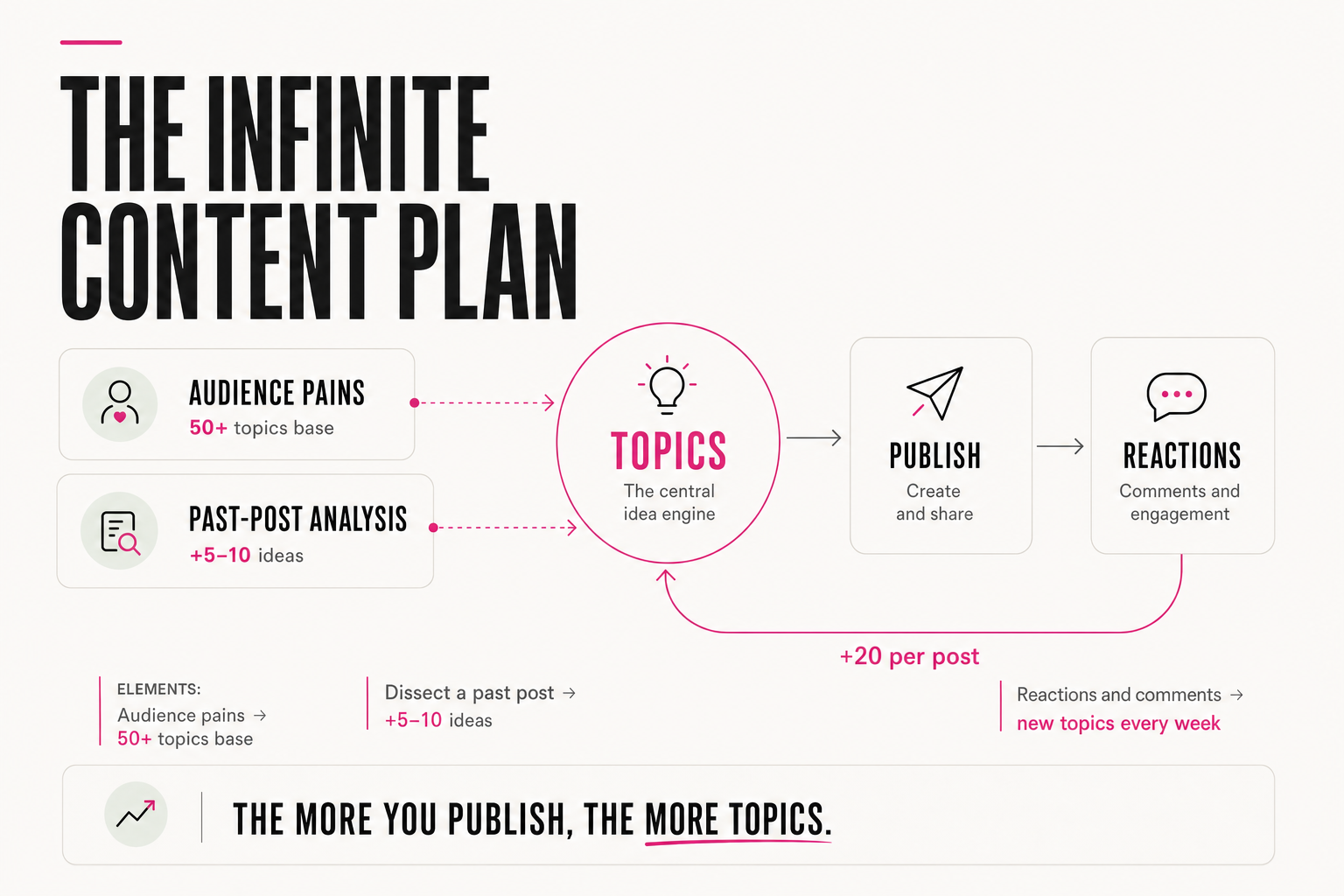
Add the two sources together and you get a loop that doesn't run dry: the more you publish → the more reactions → the more new topics → the easier to plan. You don't invent topics from your head, you collect them from what the audience actually cares about, and every post tosses up the next batch.
Sit down to invent → burn out in a week → "out of ideas."
Pains + past-post teardown → 50+ topics base, +20 after each strong post.
So "I'm out of ideas" almost always means "I invent them from my head instead of collecting them from the audience." Change the source and the problem disappears.
06 — In practice
How do you launch this system for yourself?
Set it up once and keep it alive:
- One-time: pull your audience's pains through a structure (the awareness ladder) → a base bank of 50+ topics.
My audience: [describe the niche]. Split by awareness-ladder levels (unaware of the problem → aware but not seeking a fix → searching → comparing → ready to buy). For each level, give 3-5 real pain phrasings and 3 post ideas for that level. - Weekly, 15 minutes: run 1–2 posts that landed (yours and competitors') through the teardown prompt above → +10–20 topics.
- Rule: plan for the week, not the month; the next week is built on the last one's reactions.
Don't ask AI to invent topics. Ask it to help collect them — from the audience's pains and from what already worked for you. Then ideas don't run out, because the audience itself produces them.
FAQ
Why doesn't "ChatGPT, give me 50 topics" work?
Because with no input the model returns the most likely thing — the internet's average, a templated list everyone has seen. Ideas come not from the void but from reality: your audience's pains and what already worked for you. AI should help collect topics, not invent them.
How many topics does this system really give?
A base of 50+ from audience pains, and after each strong piece another 10–20 — from dissecting the post and its comments. It's a self-replenishing source: the more you publish, the more reactions and the more new ideas appear every week.
Why not plan a month ahead?
Because within a week the audience shows you with reactions what they care about. A rigid month plan forces you to ignore that signal — the most valuable source of topics. Plan for the week and build the next one on what landed and what people wrote in the comments.
Does this only work for bloggers?
No — for anyone making content: experts, brands, services. Every audience has pains, and analyzing what landed works in any niche. Only the topic of the pains changes; the system itself — find pains plus dissect the past — is universal.