Sora's API shuts down September 24. Here's what replaces it
OpenAI is closing the door on Sora for good. A four-question picker for which of the three real replacements fits the B-roll you actually shoot.
01 — The date
What exactly is shutting down, and when?
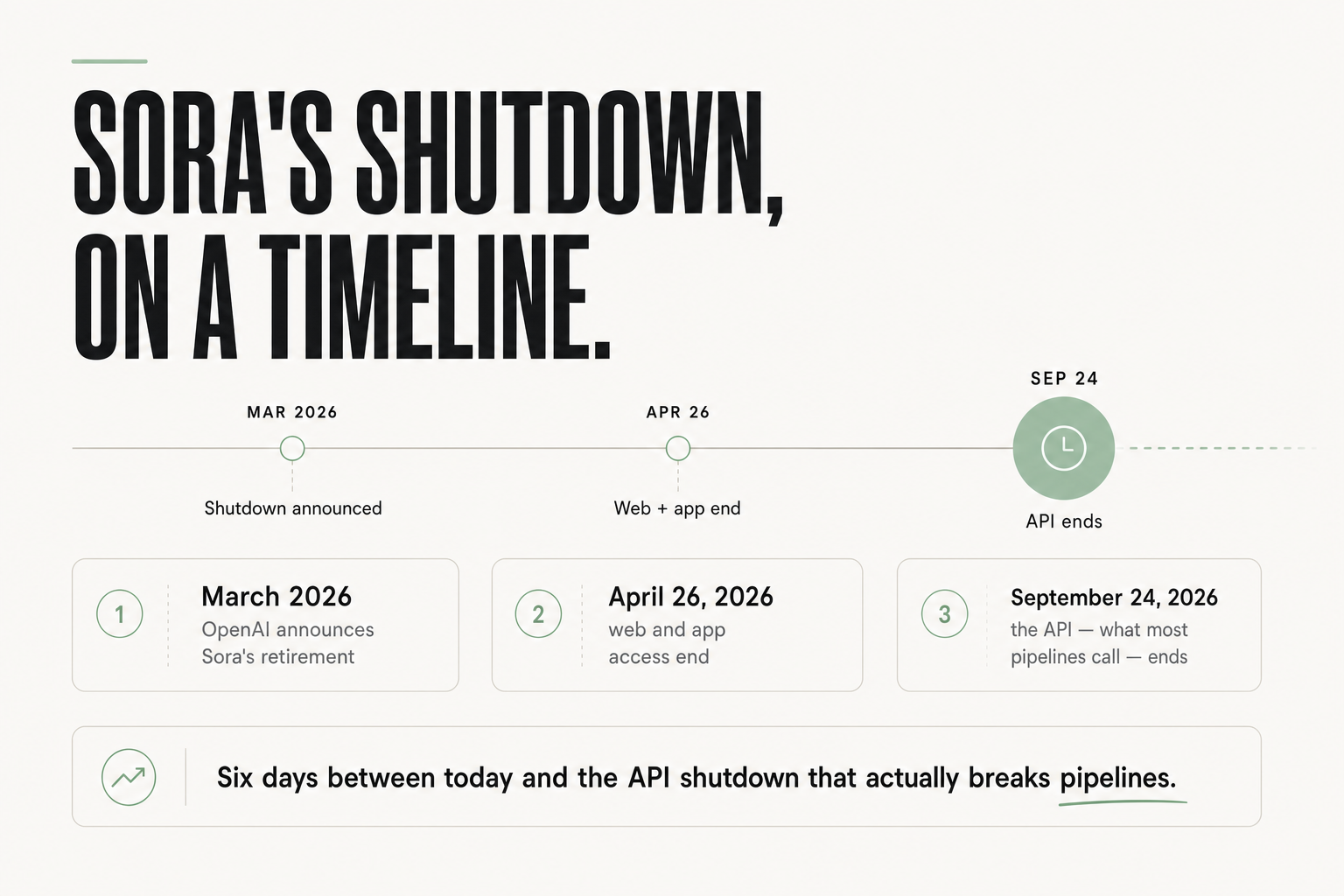
OpenAI announced in March 2026 that it was retiring Sora in two stages. The consumer-facing product went first — web and app access ended April 26, 2026. The part most people building workflows actually depend on is the second stage: the Sora API shuts down September 24, 2026.
The Sora website and app — anyone still linking to a Sora generation there is linking to nothing.
The API — any script, automation or tool calling Sora programmatically stops returning results.
If your B-roll pipeline calls Sora through code rather than the app, this is the deadline that matters to you, not the one from April.
02 — What breaks
What actually breaks if you were building on Sora?
Three things, in order of how often people miss them until it's too late:
☐ Any n8n/Zapier/custom script with a Sora API key or endpoint
☐ Any saved prompt template you reuse "the Sora way" — the
  phrasing that worked for Sora won't transfer 1:1 to another
  model's training data
☐ Any content calendar assuming Sora-generated clips land on
  a specific day this week
☐ Any client deliverable that named "Sora" in the contract or brief
The prompt-phrasing point is the one people underestimate. Each video model was trained differently — a prompt tuned for Sora's quirks doesn't reliably reproduce the same result on Runway or Kling. Budget an afternoon to re-test your go-to prompts on the new tool, not just swap the API key.
03 — Pick your replacement
Which tool replaces Sora for your kind of shot?
There isn't one Sora replacement — there are three, and they're good at different things. Answer honestly, not aspirationally: what did you actually use Sora for most, not what you wish you'd used it for.
04 — Runway Gen-4.5
When is Runway Gen-4.5 the right call?
Runway Gen-4.5 currently tops the Artificial Analysis Text-to-Video leaderboard at 1,247 Elo. It generates native audio alongside the video, offers frame-level camera control, and — the part that matters for a real edit — keeps characters consistent across shots when you feed it a reference image.
Use Runway Gen-4.5 when the clip is going INTO an edit, not
straight to publish: you need camera control you can direct
("slow pan left, hold on the product"), the same character or
product across 3+ shots, and you'll color-grade or composite
afterward. Feed it a reference image of your product/person —
consistency across shots is its strongest edge.
05 — Kling 3.0
When is Kling 3.0 the right call?
Kling 3.0 does one thing none of the others do at the same quality: clips up to five minutes long. Combined with a free evaluation tier and low subscription pricing, it's the option for producing at volume without burning a large budget — and on high-motion, dramatic or action sequences it has repeatedly outperformed pricier tools.
Editable, camera-controllable, consistent characters — costs more, built for the shot you'll cut into a finished edit.
Long clips, cheap at volume, strongest on motion — built for the B-roll you generate in batches and barely touch after.
06 — The two-model pattern
Why do most teams pair two models, not one?
The production pattern that's become standard in 2026 isn't "pick a winner" — it's pairing two: Seedance 2.0 for the bulk of B-roll and continuity shots, plus Runway Gen-4.5 or Veo 3.1 for the one hero shot that justifies the higher per-clip cost.
Hero shot (opening 3 seconds, the one people remember):
  Runway Gen-4.5 — editable, on-brand, worth the cost
Bulk B-roll (remaining 27 seconds, 6-8 short clips):
  Kling 3.0 or Seedance 2.0 — fast, cheap, good enough at
  volume because no single clip carries the whole ad
Result: total spend closer to "all Kling" pricing, but the
first 3 seconds — where people decide to keep watching — is
the expensive, controllable version.
This is the same logic as picking a hook for a written post: the part that decides whether someone stays gets the extra investment; the part that just needs to exist doesn't.
07 — Migrate this week
What do you actually do before the 24th?
Run the audit in section 02, pick your replacement from section 03, and re-test — don't just re-key — your two or three most-used prompts on the new tool before you need them for a real deliverable.
1. Audit (5 min): run the checklist in section 02
2. Pick (2 min): answer the 4 questions in section 03
3. Re-test (30-60 min): take your 2-3 best Sora prompts, run
   them on the new tool, compare output before a client sees it
Do this before the 24th, not after something breaks live.Sora's shutdown solves itself with the right tool for the shot — Runway, Kling or Veo, picked honestly above. The part that doesn't get solved by swapping video models: still explaining your brand's fonts, colors and tone to a new AI tool from scratch every time. That's the twenty-minute fix for your carousels, decks and posts in Teach Claude Your Style, free.
FAQ
When exactly does Sora shut down?
In two stages. OpenAI ended web and app access on April 26, 2026. The Sora API — what most automated B-roll pipelines actually call — shuts down September 24, 2026. If you're linking to Sora through code, the September date is the one that affects you.
Is there one direct replacement for Sora?
No — the three real options split by use case, not by being "the same but newer." Runway Gen-4.5 for editable, camera-controlled shots you'll cut into a finished edit; Kling 3.0 for high-volume, high-motion, budget-conscious B-roll with clips up to 5 minutes; Veo 3.1 for one polished hero clip with native synced audio.
Will my old Sora prompts work on the new tool?
Not reliably. Each model is trained differently, so phrasing tuned to Sora's quirks doesn't reproduce the same result elsewhere. Budget time to re-test your go-to prompts on the replacement rather than assuming a straight copy-paste.
Why do production teams use two video models instead of one?
Cost and quality don't scale the same way across a whole video. The common pattern for 2026 is Seedance 2.0 for bulk B-roll and continuity shots, paired with Runway Gen-4.5 or Veo 3.1 for the one hero shot — usually the opening seconds — that justifies the extra cost and control.