AI that sells for you: an assistant that answers "why should I buy this"
90% of buying decisions are subconscious. Here are five stages of analysis that make an offer hit the real reason, not the feature list.

01 — The main question
Which client question does your copy fail to answer?
Every client has one main question in their head: "why should I buy this." And most selling copy doesn't answer it — it explains what the thing is (modules, features, contents), not why it's needed by this particular person.
That's the gap: you describe the product, the person is looking for a reason. They don't buy "6 modules" — they buy what those modules will give them. A strong offer starts not with listing features but with answering "why," and that answer has to be dug out first.
"6 modules, 40 lessons, a year of access, bonuses" — a feature list that explains nothing about the reason to buy.
"You'll stop spending an evening on a post you're embarrassed to publish" — a concrete reason the reader recognizes in themselves.
02 — The subconscious
Why don't features sell?
About 90% of buying decisions happen subconsciously. A person first feels "yes, this is for me," then assembles rational justifications. So a list of specs doesn't move anything: it's addressed to the conscious part, which kicks in last.
People buy not the product but the real reason underneath it. Features justify the purchase after the fact — but they don't trigger it.— Anjela Petkova
So the offer's job is to hit the real driver: which pain it removes, who the person becomes, what emotion it evokes. And to get there, the product has to be taken apart deeper than "what's included."
Take a line from your offer and ask:
1) Does this describe the product or a consequence for the client's life?
2) Would the client nod "yes, that's me" — or shrug "so what"?
3) Is there an emotion here (fear, relief, pride) — or just a fact?
2+ "fact/shrug" answers? That's a feature, not a driver.
03 — Five stages
How do you dig out the real reason to buy?
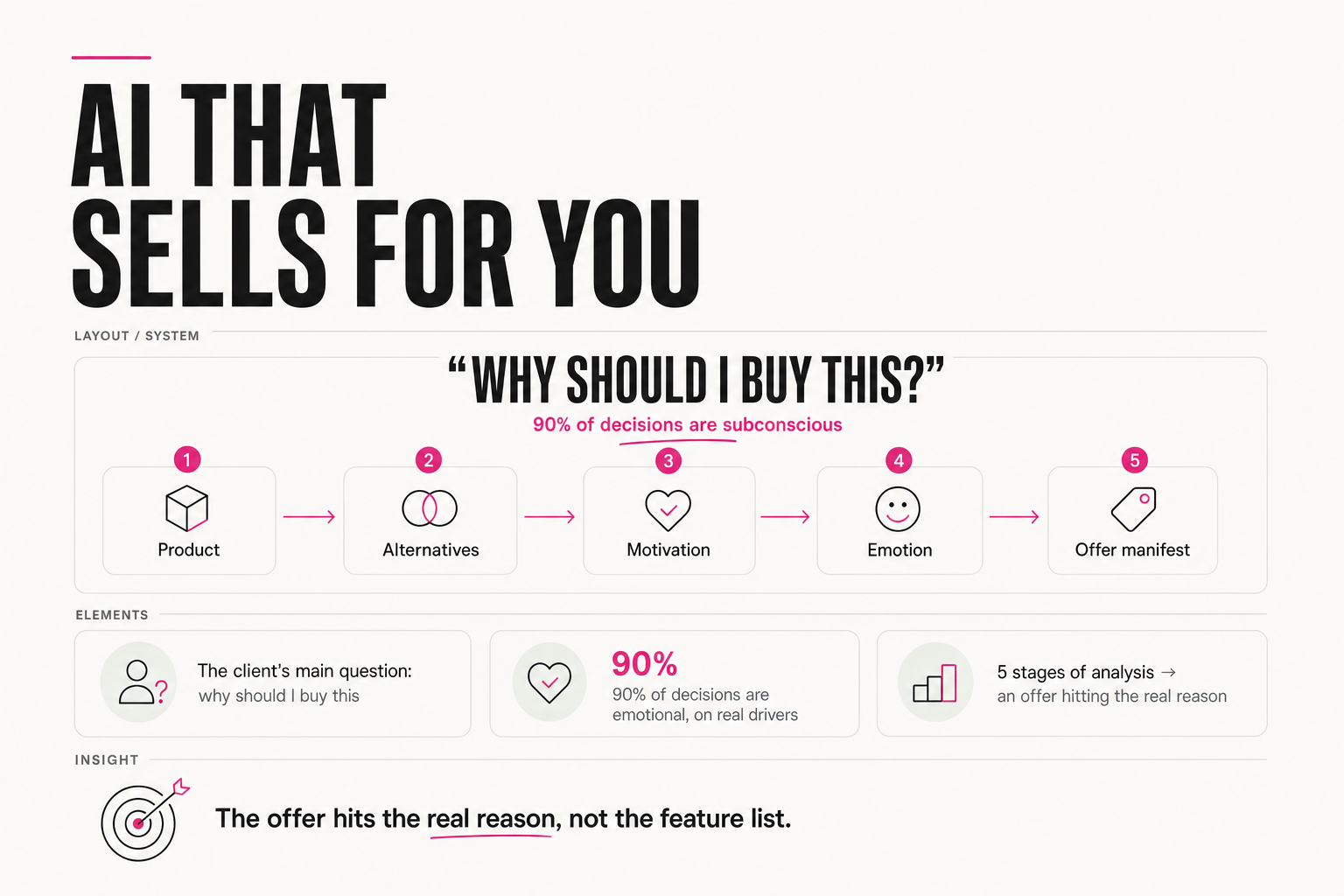
For an offer to answer "why," run the product through five stages of deep analysis:
1. The product request — what you really sell (not features, the essence)
2. Alternatives — what the client tried before you and why it failed
3. Pure motivation — the true drivers of the buying decision
4. Natural reaction — what emotions the offer should evoke
5. Manifest — offer variants for different jobs and segments
Notice the logic: first alternatives and failures (why the past didn't work), then true motivation, and only at the end — the phrasing. The offer is born from understanding the client, not from your list of advantages.
04 — The assistant
Why should this be an assistant, not a one-off prompt?
You can go through these five stages once by hand. But it's stronger to build an AI assistant that runs any of your products through them: it asks the right questions in order, studies the product and audience deeply, and outputs offers for different jobs.
The difference is the same as everywhere: a one-off prompt solves a task once; an assistant with the method baked in does it every time, consistently. A new product, a new landing page, a new audience — you run them through the same deep analysis in minutes, instead of assembling an offer from scratch on instinct.
You're an assistant that analyzes a product before an offer is written.
When given a product description, ask questions strictly in order:
1) what we actually sell (not features, the essence)
2) what the client tried before and why it failed
3) the true drivers of the decision (ask about emotion, not just logic)
4) what reaction the offer should trigger
Only after all 4 are answered — propose phrasing options.
05 — The limit
What in selling can't you hand to AI?
AI runs the analysis and phrases beautifully — but it doesn't know the truth about your product and market. Those you bring:
- What clients actually tried before you and why it failed — from calls and messages, not guesses.
- Real results and proof — numbers, cases, reviews that can't be invented.
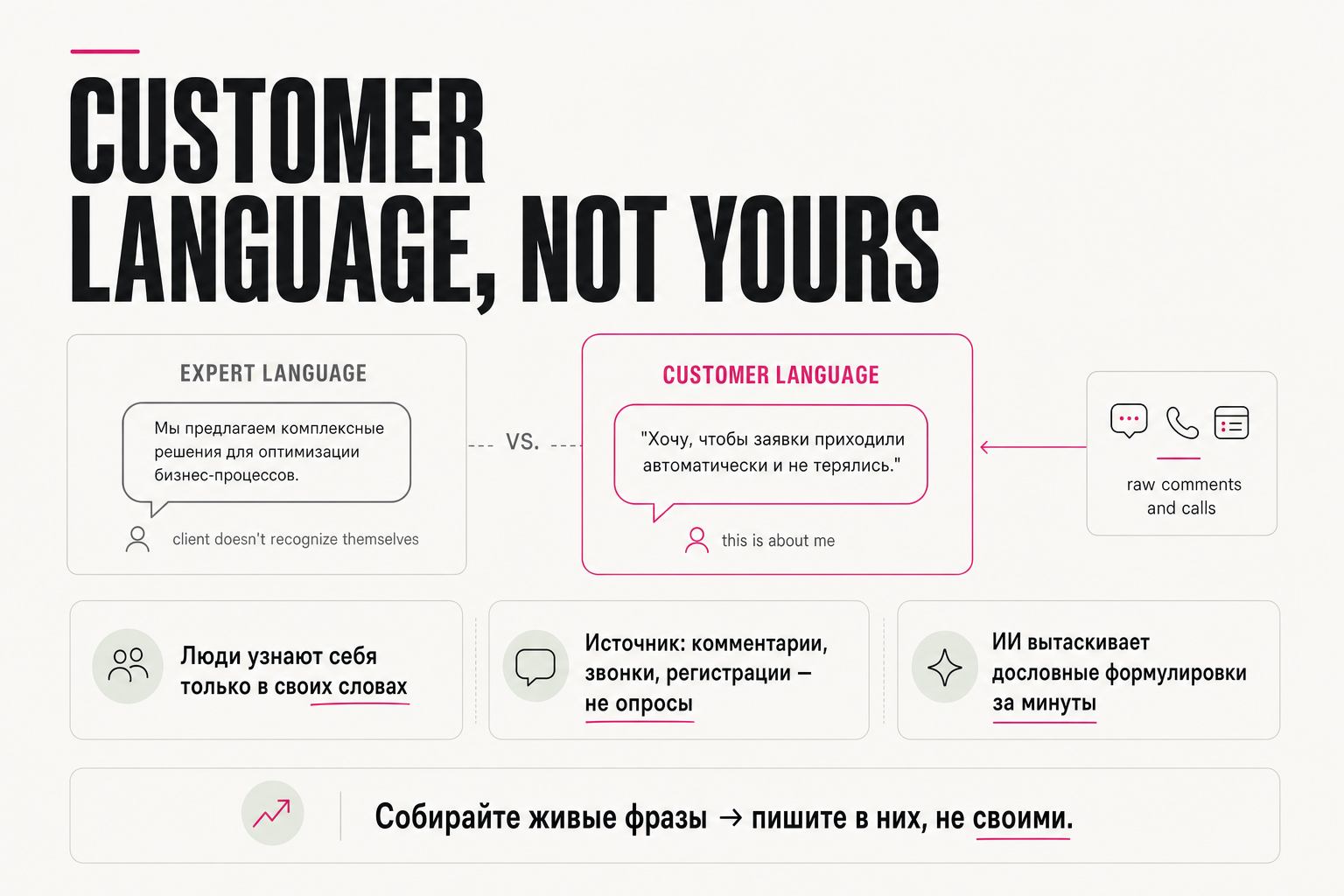
- The client's language — verbatim phrasings of the pain the offer must hit.
Give the assistant this raw material and it builds an offer that lands. Don't, and you get smooth but empty "about the product" copy. AI amplifies the understanding of the client that you have; it can't invent it for you.
Here are 10-15 messages from clients (requests, questions,
objections): [paste them].
Pull out the verbatim pain phrasing — no rephrasing.
Group the similar ones. Drop my guesses about "what they meant" —
only their own words.
06 — Where to start
Where do you start right now?
Take one of your products and walk through the five stages — even without an assistant, in a regular chat. Start with "what did the client try before me and why didn't it work": that one question often uncovers the real reason to buy more powerfully than your whole list of advantages.
Here's my product: [describe freely].
Here's what clients tried before me and why it didn't work:
[2-3 examples from memory or chats].
Based on this — what real reason to buy might I be missing
in my current offer?An offer sells when it answers "why," not "what." Dig out the real reason through five stages, build it into an assistant — and feed it the truth about your product and the client's language. AI amplifies your understanding, but won't replace it.
FAQ
Why doesn't my selling copy sell even though everything is described?
It most likely answers "what it is" rather than "why I need it." The client looks for the reason under the purchase, not a feature list. About 90% of decisions are made on emotion and real drivers, so listing specs doesn't move anything — it's addressed to the conscious part, which kicks in last.
What are the five stages of product analysis?
The product request (what you really sell), alternatives (what the client tried and why it failed), pure motivation (the true drivers), natural reaction (what emotions the offer should evoke), and the manifest (offer variants for different jobs). The logic runs from understanding the client to the phrasing, not the other way around.
Why build an assistant if I can just ask once?
A one-off prompt solves a task once, while an assistant with the method baked in runs any of your products through the five stages consistently. A new product or landing — you run it in minutes instead of building an offer from scratch. It turns a one-time analysis into a repeatable process.
What in this process can't be trusted to AI?
The truth about the product and market: what clients actually tried before you, real results, numbers and reviews, the verbatim language of the pain. That can't be invented — take it from calls and messages. AI amplifies the client understanding you bring, but doesn't create it for you.