The expert in 2026: clients go to ChatGPT, not you. What to do
Expertise is being devalued en masse — but not for everyone. What separates those AI will amplify from those it'll replace with "ChatGPT plus a prompt."

01 — The new reality
What changed for experts in 2026?
Clients no longer look for specialists — they open ChatGPT, type "you're a super psychologist/consultant with such-and-such credentials," and think AI becomes an expert from one prompt. AI creates an illusion of personalization, gives a templated answer — and people transfer that experience onto all experts at once.
And nobody seems to care that the specialist has years of experience, piles of cases, a trained eye. The competition changed: now an expert competes not with another expert but with free ChatGPT in the client's hands.
"You're an experienced psychologist with 15 years specializing
in anxiety. I have [situation]. Give me an action plan like
in a session."
→ ChatGPT returns a structured, confident-sounding plan.
→ The client can't tell it from a real specialist's plan — until
  they try applying it and hit the fact that the scheme didn't
  account for their specific case.
02 — Everywhere
Why does this hit every niche at once?
It's not one industry's problem. Psychology, consulting, coaching, marketing, education — everywhere the same thing: the client thinks "why pay if ChatGPT gives the same for free?"
And the answers really do sound similar — because most experts can't explain the difference. Expertise is devalued not because AI got better than the expert, but because on the surface their answers are indistinguishable. And if they're indistinguishable, the client picks free.
For the first time, experts compete not with each other but with free AI in the hands of their own clients.— Anjela Petkova
1. Take your latest reply to a client (a post, a consult, an email)
2. Run the same question through ChatGPT with no context
3. Compare: is there anything in your answer ChatGPT COULDN'T
   have written — a specific detail from your practice, a nuance
   that isn't googleable?
If no — you're still competing with free. If yes — that's exactly
what needs digitizing in the next step.
03 — The trap
Why does "why pay if it's free" work?
The trap isn't that ChatGPT actually replaces the expert. It returns a plausible average — and a client without a trained eye can't see why it's worse than a professional's work. Meanwhile the expert, used to working by feel, can't put into words what exactly they do differently.
"ChatGPT's answer and the expert's sound the same → I pay 0."
Behind the expert's answer: a thousand cases, nuances, a plan B. But it's unarticulated, so it's invisible.
So the one who loses isn't the weakest expert but the one who can't show their difference. In 2026, invisible expertise is priced like free.
04 — What protects you
What actually protects an expert from replacement?
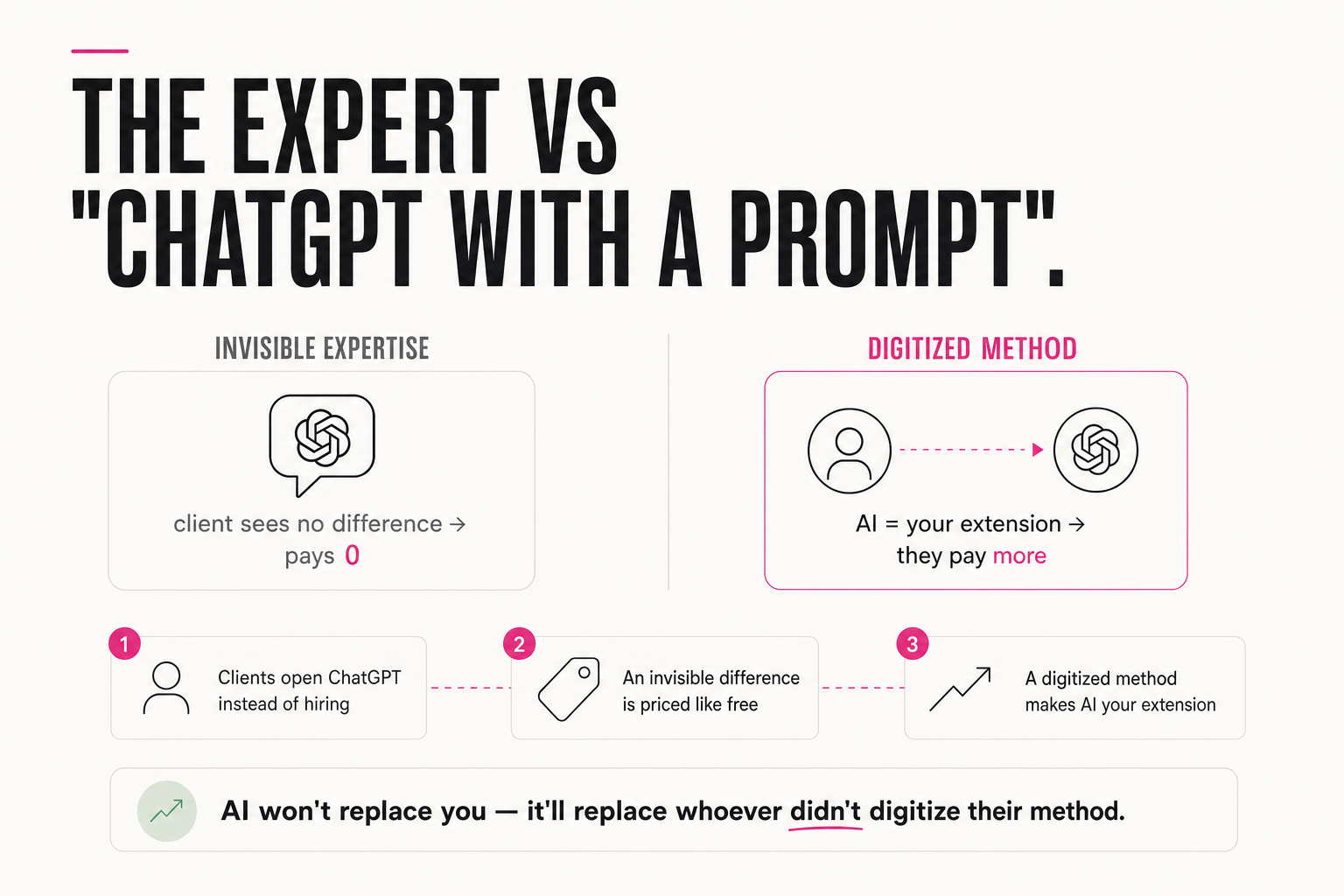
AI can't replace YOU and your experience — that's the most valuable currency. But you won't lose to AI's advance only in one case: if you unpack your expertise for it. What can't be described in a prompt has to be extracted and digitized:
- How you make decisions in hard cases — and why exactly that way.
- Which nuances you see after a thousand cases.
- What you do when the scheme fails.
Then your AI becomes an extension of your expertise, not a competitor to ChatGPT's advice. And that difference clients already feel.
"Here are 3 real cases of mine with different outcomes:
[describe briefly]. Analyze what I did the same across all
three — which questions I asked first, what I paid attention
to, at what point I changed approach. Phrase it as a step-by-step
method I can hand to a model as an instruction."
05 — What changes
What changes once you've digitized your method?
When AI works by your method rather than as a "separate unit," the game flips:
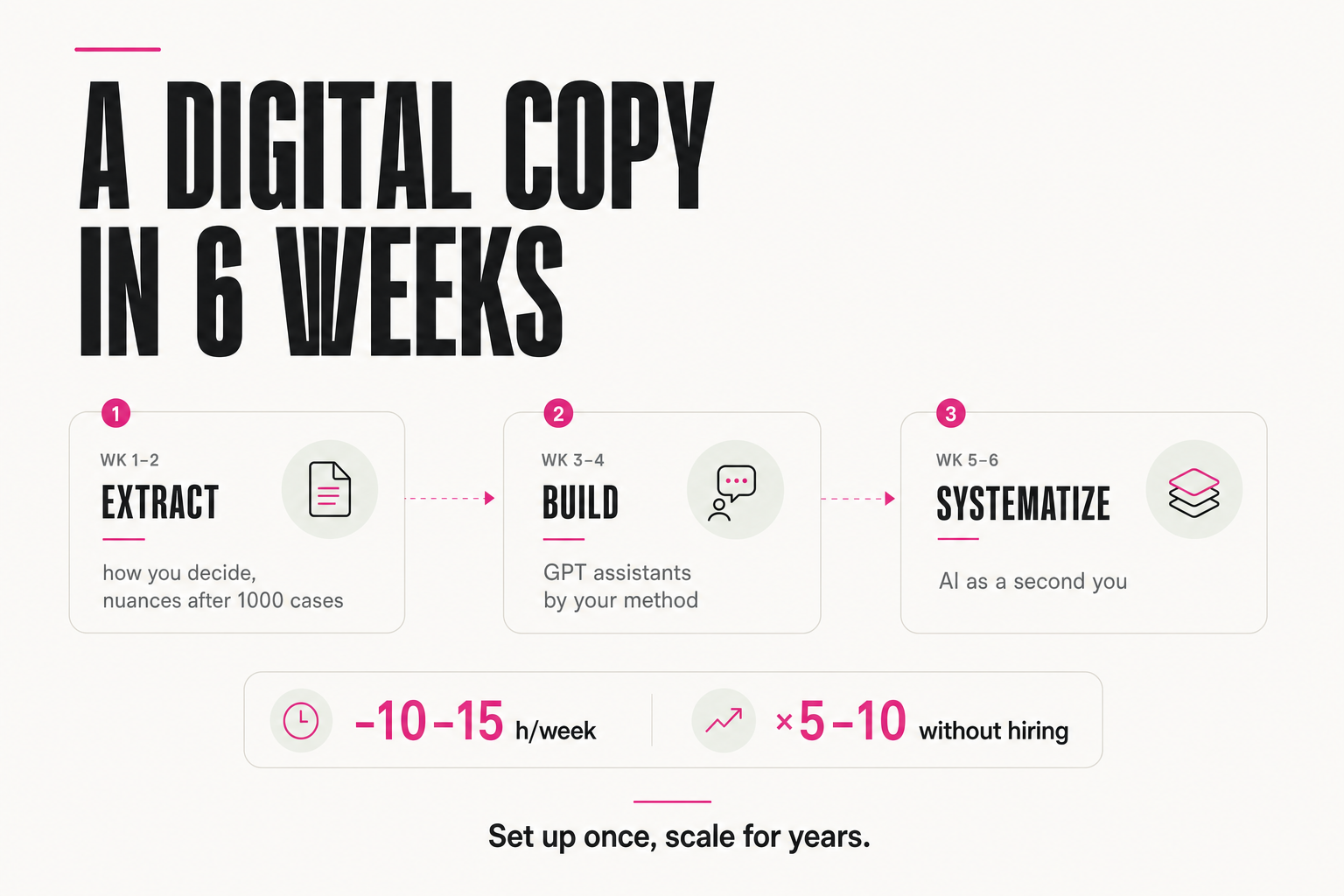
- You free up 10–15 hours a week — AI takes the routine, you take more clients without burnout.
- People pay more, because they see the difference between you and "ChatGPT with a prompt."
- You scale without hiring — your digital version holds the routine.
The client compares you to free ChatGPT → sees no difference → haggles on price or leaves.
The client sees your AI assistant answer more precisely than a generic chat → that's visible proof of the difference → they pay for it.
The paradox: what saves you from AI isn't fighting AI but mastering it — the same tool that devalues invisible expertise massively amplifies the digitized kind.
06 — What to do
Where do you start right now?
Start by articulating the difference — even before any automation. Take a typical client request, run it through ChatGPT, and honestly answer: what would you do differently and why. That gap between the "average answer" and yours is your expertise — and it's time to pull it out of your head.
Day 1: take 1 typical request → run it through ChatGPT →
       write down how your answer differs
Days 2–5: repeat on a new request every day
Day 7: you have 5 recorded differences — a draft of your
method you can hand to an assistantIn 2026 the one who loses isn't the weak expert but the invisible one. AI won't replace you — but it'll replace whoever didn't digitize their method. Make AI an extension of your expertise, and it turns from a threat into your biggest amplifier.
FAQ
Does AI really replace experts?
It doesn't replace — it creates an illusion of replacement. ChatGPT returns a plausible average, and a client without a trained eye can't tell it from a professional's work. What gets replaced isn't expertise but the expertise an expert can't show and explain. An invisible difference is priced like free.
Why do clients pick ChatGPT over a specialist?
Because on the surface the answers sound similar, and most experts can't explain the difference. The client thinks "why pay if it gives the same for free." The one who loses isn't the weakest but the one who never articulated what exactly they do differently.
What does "digitize your expertise" mean?
Extracting what can't be described in one prompt: how you decide in hard cases, which nuances you see after a thousand cases, what you do when the scheme fails. Moved into AI, that method makes your assistant an extension of you, not a copy of generic ChatGPT.
Where do I start protecting my value?
By articulating the difference. Run a typical client request through ChatGPT and honestly describe what you'd do differently and why. That gap is your expertise — first make it visible, then digitize it so AI amplifies it instead of replacing it.