You're using AI at level one of three. Here's how to move up
A step-by-step map: the signs of each level and what to do to move up.

00 — The map
Where's the gap between "I use AI" and "I scale with AI"?
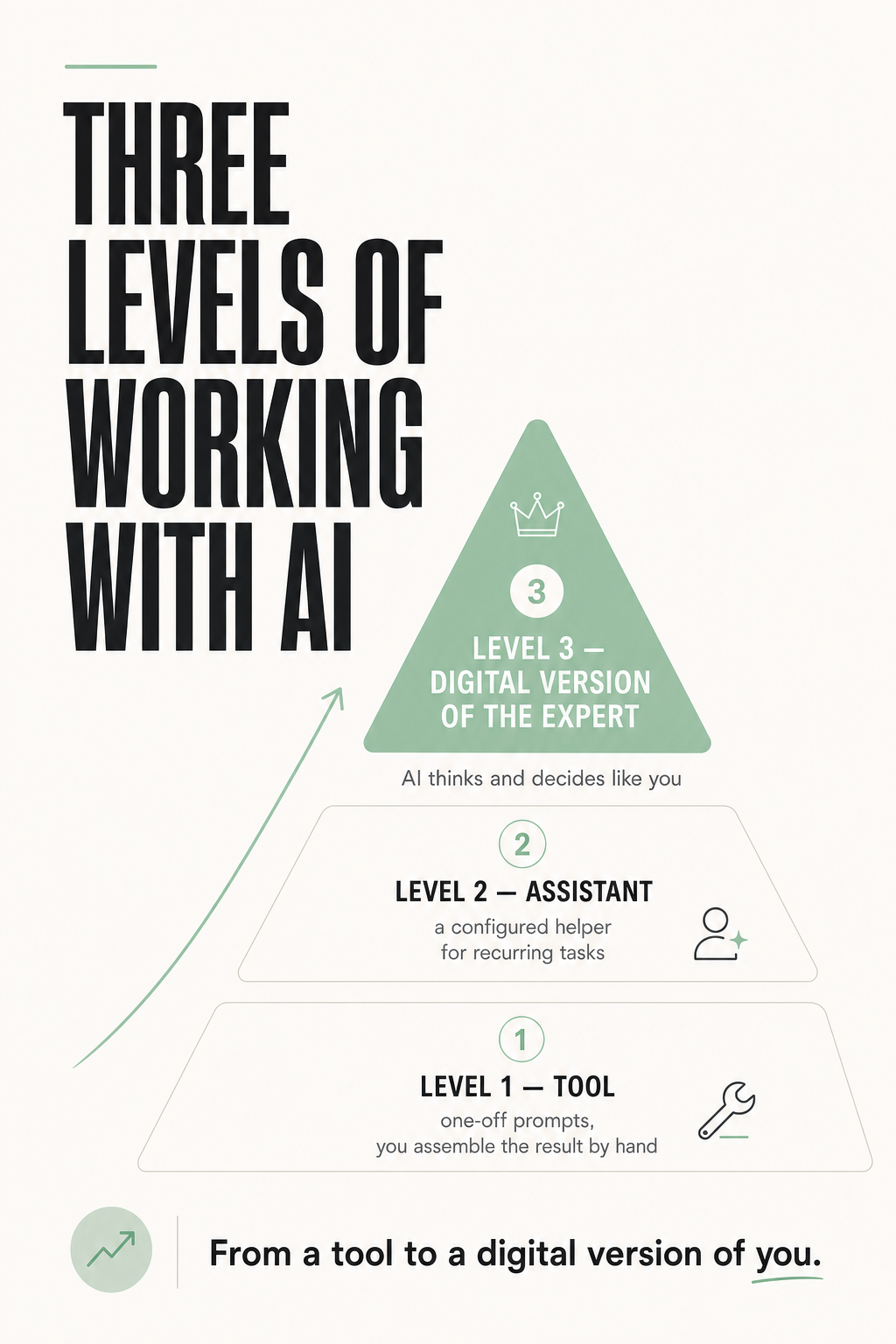
This gap is invisible while you stand at its edge. From the outside everyone seems to "use ChatGPT" about the same: some write posts, some draft emails, some ask for ideas. But behind the same words are three fundamentally different modes — three levels.
And the difference isn't which model you open — it's how much of you lives in it. We'll break down each level by one template: what it is, how it looks in practice, what you can do at it, and what holds you there.
Task: "reply to a client who said the price is too high"

L1: "Write a reply to a price objection" → a template about
    value that has to be rewritten in your style
L2: same request in a project with your voice → sounds like
    you, but the arguments are generic
L3: AI knows your logic for this objection (ask about budget,
    not justify the price) → a ready reply
01 — Tool
Level 1: AI as a tool — why are most people here?
What it is. AI is a smart search box and draft generator. You open the model, give it a role and a prompt, get a generic template — and close it.
How it looks. You type "write a post about marketing," get text that sounds like everyone's, rewrite it because it's faceless, and close the chat. Tomorrow — from scratch again, re-explaining who you are.
What you can do: speed up the routine maybe 2×, get a base draft so you don't face a blank page. What holds you: every output is the internet's average, and you start from zero every time. The ceiling here is "a bit faster, but still doing it yourself."
Answer: 1) Do I explain who I am and what I do in a new chat?
2) Do I rewrite more than half of the final text?
3) Do I have zero saved prompts or projects?
2+ "yes"? You're at level one. Section 02 shows where to go next.
02 — Assistant
Level 2: AI as an assistant — what changes?
What it is. About 10% of people are here. AI already knows your style and your approach. It gets you in half a sentence, asks clarifying questions, and delivers something you nudge rather than rewrite.
How it looks. You set a task — without re-explaining who you are and how you sound. AI holds your context, checks the non-obvious, offers options in your logic.
"Write a post about X" → faceless text → I rewrite all of it.
"A post about X" → in my voice, with my angle → I fix a couple of lines.
What you can do: work 3–4× faster and lean on AI that helps you think, not just type. What holds you: AI knows your style but not yet your decision logic — the hard calls are still on you.
03 — Digital version
Level 3: AI as a digital version of you — what does it give you?
What it is. Fewer than 5% of people are here. AI knows not just your style — it knows how you think: how you decide in hard situations, what questions you ask to get to the core, what logic you use when working through a client's problem.
How it looks. You pulled your approach out of yourself — the things you do on autopilot and don't even notice — digitized it and moved it into the model. Now you can scale yourself without losing quality: not "one more draft," but decisions in your logic that only you could make before.
The difference between levels isn't the model. It's how much of your judgment you've moved into it.— Anjela Petkova
Here's what it looks like in practice: a hard request comes in — a non-standard case that normally needs you personally. Your digital version asks the same clarifying questions you would, cuts the unsuitable options against your red flags, and prepares a reply in your logic — and you just confirm it. The "bottleneck = you" that used to cap your growth is gone at level three.
What you can do: hand off whole chunks of expert work and get them back at your quality. What holds you: only one thing — whether you've digitized your method. That's the work of level three.
Recall a hard case where you made a non-standard call:
[describe the situation and what you did].
Explain to AI: what 3 questions you asked yourself before
deciding, what red flag you noticed, why you picked that option.
Ask it: "next time a similar case comes up, ask me these same
questions first, before proposing a solution."
04 — What's next
How do you pass all three levels — faster than you'd think?
The good news: the path is walkable. In AI focus groups about 98% of participants start at level one — we've all been there. In two weeks people move to the second, then reach the third and build their digital versions: they start to understand their own expertise and what exactly sets them apart.
Start not by hunting the perfect prompt, but with an honest question: which level are you on right now?
Re-explain context every time and rewrite the draft? → L1
AI holds your style, you fix a couple of lines?     → L2
AI decides in your logic, you hand off chunks?      → L3
Then one step at a time: gather context into a project (voice → assistant), then digitize your method and criteria (logic → digital version). Don't hunt a magic phrasing — transfer yourself.
FAQ
How is the "assistant" level different from the "tool" level?
At the tool level you re-explain context every time and rewrite a faceless draft. At the assistant level AI already knows your style and approach, gets you in half a sentence, asks clarifying questions, and delivers something you nudge rather than rewrite. Speed goes from 2× to 3–4×, and AI starts helping you think.
What does a "digital version of an expert" mean and why do you need it?
It's the third level, where AI knows not just your style but how you think and decide. It lets you scale yourself without losing quality — handing off whole chunks of expert work and getting them back in your logic, not just another average draft.
How long does the move take?
In practice faster than you'd think: in focus groups about 98% start at level one and, within two weeks, move to the second and then the third. Speed depends not on the model but on how systematically you transfer your context and method.
Where do I start right now?
With the honest question "which level am I on." If you re-explain context every time, you're on the first. Then one step at a time: gather voice and examples into a project (that gives you an assistant), then digitize your decision logic (that gives you a digital version).