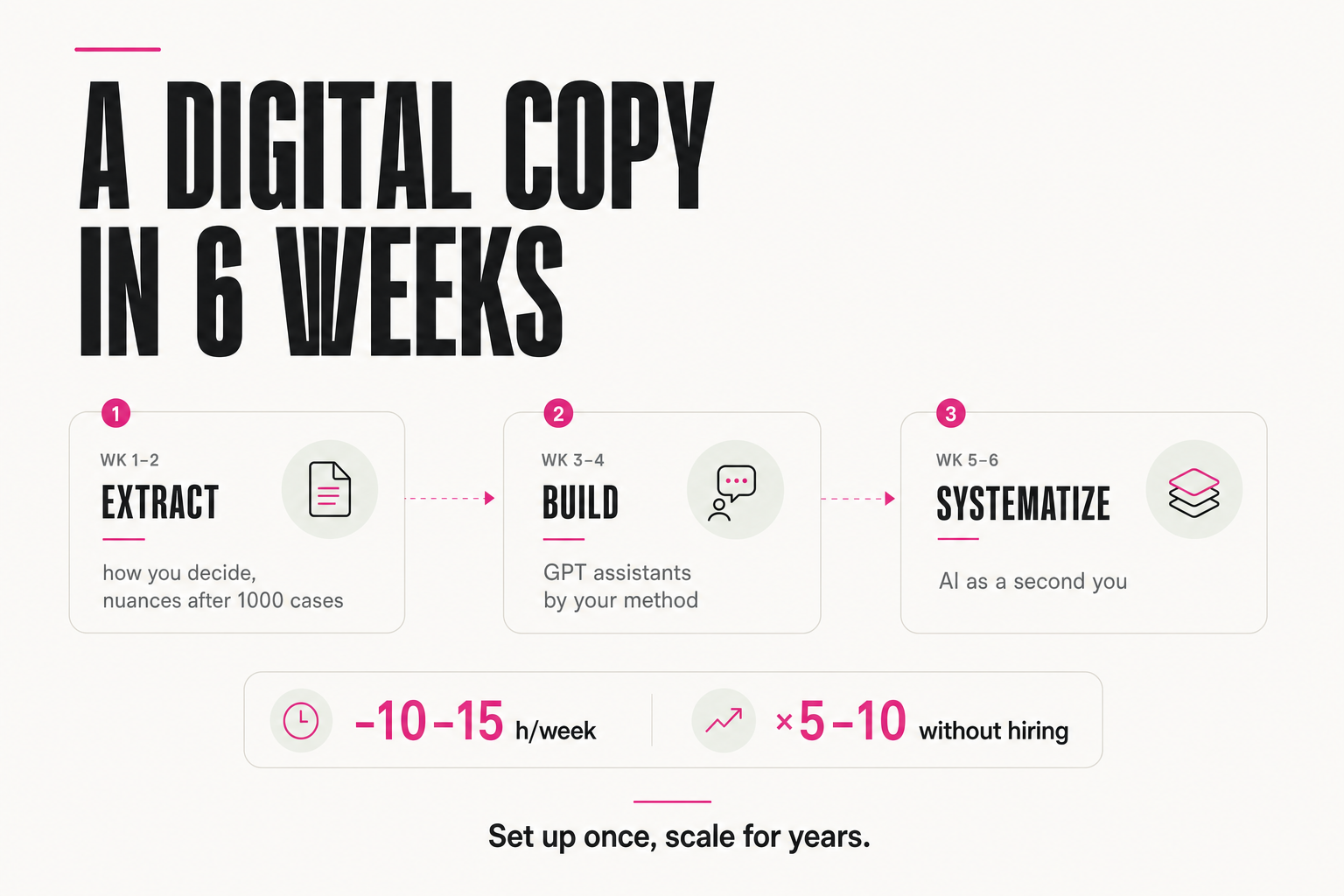
AI for realtors: how a 20-year agent became a technologist
A bot with 1000+ contacts converting at 10–15%, a call-analysis system built in a week, and three GPTs checking each other. A real transformation, unpacked.

01 — The case
Why does the most technical case belong to a realtor?
If you asked me whose case in the base is the most "engineering-grade," I wouldn't name a single techie. It's a realtor with 20 years in the field, co-author of a course on AI in real estate — a person who hadn't written a line of code before AI.
With GPT as a mentor she learned to build scrapers and chatbots: the model wrote the code, explained it, fixed the errors — she set the tasks and checked the results. Her own summary: "I feel like a technologist of realtor processes." Not "an AI user" — a technologist. That shift is the whole story.
"I need a script that goes to [a listings site] and collects:
address, price, size, seller's phone number — into a spreadsheet.
Don't explain the code line by line, just give me a finished file
and instructions for running it on my computer (Windows, no
coding experience)." Then, one error at a time: "here's the error
text [paste it], why is this happening and how do I fix it?"
02 — The bot
How did the bot bring 1000+ contacts at 10–15% conversion?
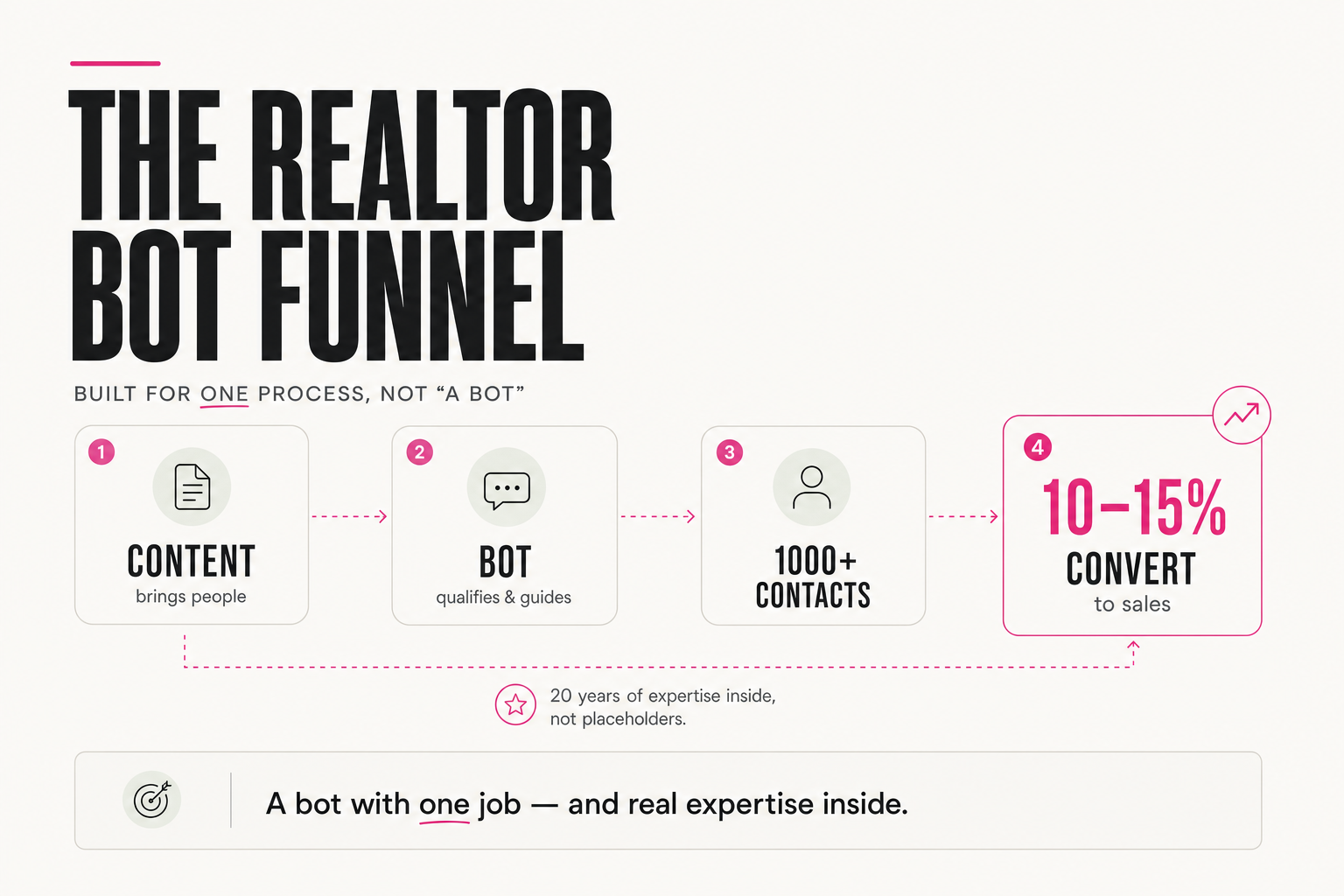
The case's headline result is a bot that works as a funnel: content brings people in, the bot qualifies and guides them, and the output is course sales. The numbers: 1000+ contacts attracted, 10–15% conversion into sales.
Why it worked: first, the bot was built for one concrete process, not "a bot for the sake of a bot" — its single job is walking a person from interest to decision. Second, 20 years of expertise is baked into it: answers to real questions, not placeholders. Third, it's flexible: a custom database handles client classification. The tools are the same for everyone — the difference is what's inside.
"Hi! Thanks for your interest, our manager will contact you" → the person leaves without an answer to their actual question.
Asks budget and area itself → checks against a database of real listings and common objections → answers specifically, books a showing.
03 — The calls
How do you build a call-analysis system in a week?
The case's second system is call analysis in ordinary Google Sheets, assembled in a week with GPT's help. The scheme: calls get transcribed → AI runs the transcripts against criteria (what was asked, which objections, what worked) → the findings land in a table.
For a realtor's business this is gold: calls are the main deal channel, yet nobody reviews them systematically. A week of setup — and you gain sight: which objections repeat, where leads leak, which phrasings sell. What analytics platforms charge serious money for came together from spreadsheets and persistence.
"Here's the call transcript [paste it]. Identify: 1) the first
question the client asked, 2) the objection raised and its exact
wording, 3) which agent phrase the client reacted to positively,
4) how the call ended. Return it as one spreadsheet row:
question | objection | phrase that worked | outcome."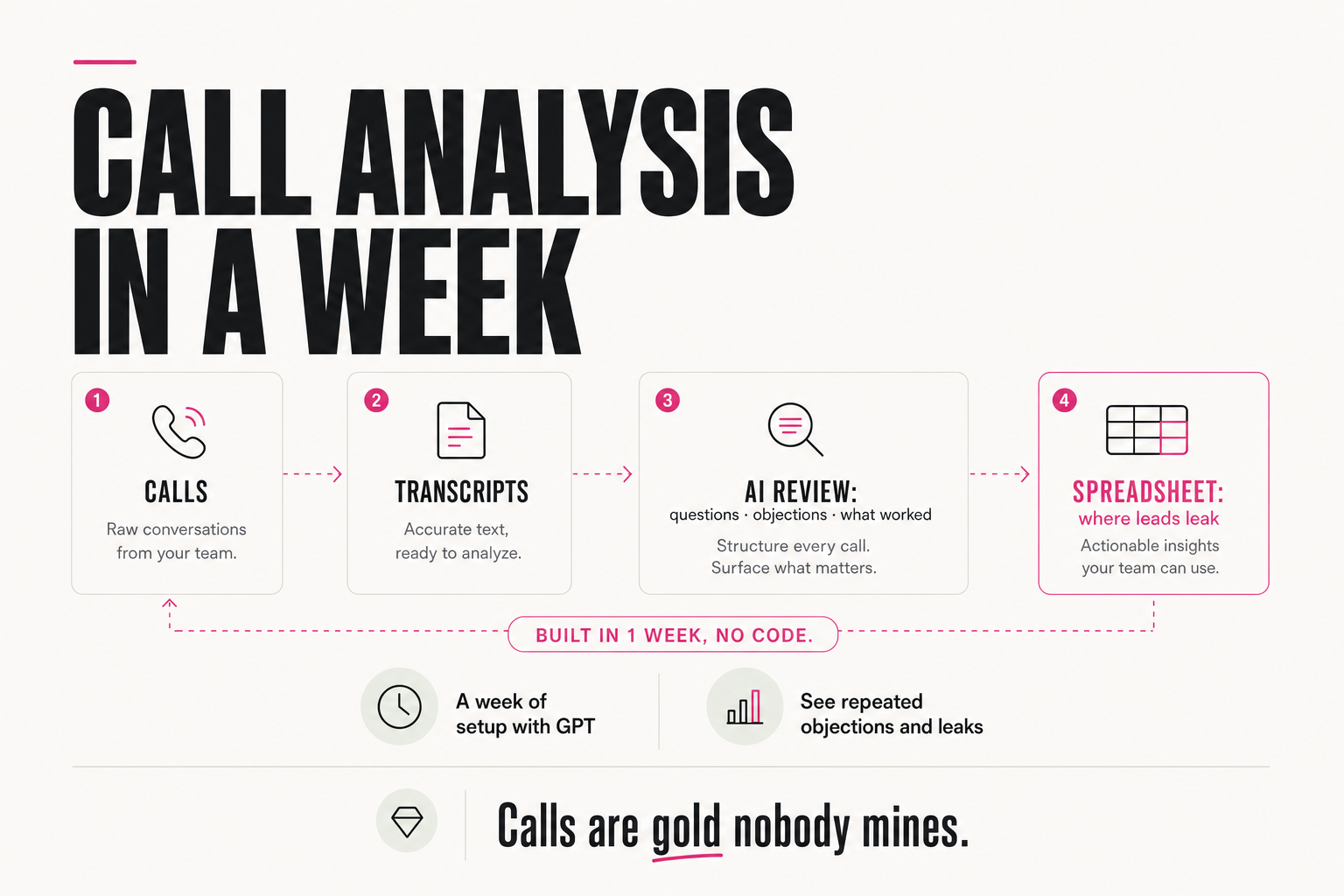
04 — The GPT trio
Why three GPTs checking each other?
The case's most elegant construction is a trio of GPTs for quality control of teaching materials: an "AI intern" goes through the material as a beginner and asks questions; an "answer master" replies from the knowledge base; an "AI examiner" checks the answers and finds the gaps.
It's a hand-built but working version of what engineering calls cross-checking: one AI doesn't grade itself — weak spots are found by colliding roles. Material that survives the trio reaches real students already road-tested. The move transfers to anything: sales scripts, SOPs, onboarding.
ROLE 1 "Intern": "Read this material as a total beginner to the
  topic. Ask 5 questions you'd genuinely have."
ROLE 2 "Answer master": "Here's the knowledge base: [paste it].
  Answer these 5 questions using only this base."
ROLE 3 "Examiner": "Check these answers for accuracy and
  completeness. Where an answer is thin or vague, say exactly
  where."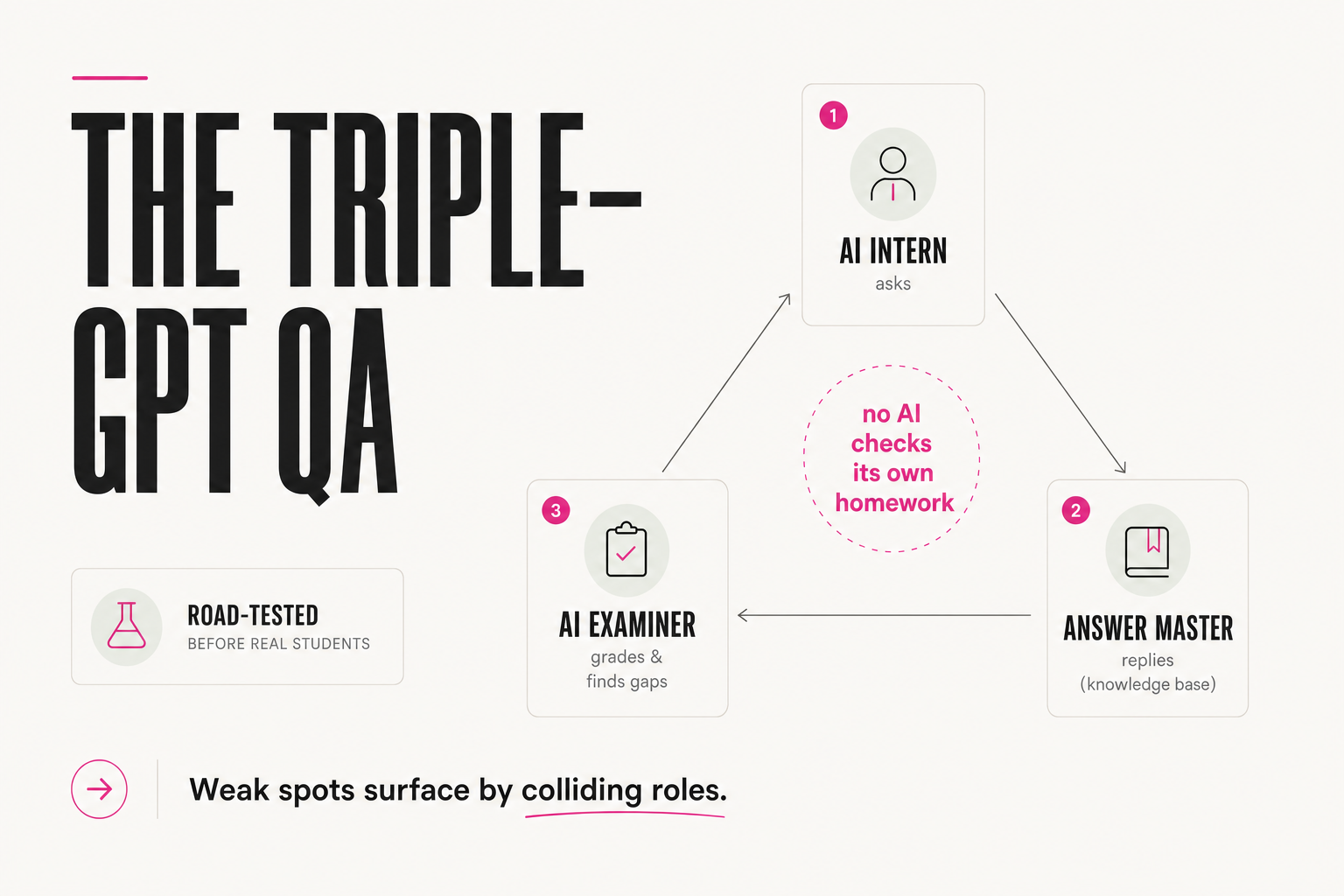
05 — The mindset
"Sell solutions to yourself": the case's main lesson
The main thing is overcoming your inner stereotypes and "selling" solutions to yourself.— a realtor from the focus group, 20 years in the field
All the technical wins of this case grew from one mental shift. The stereotype "I'm a humanities person, this isn't for me" holds people back harder than any lack of skills — and it's removed not by courses but by the first small working result.
Hence her word "selling": every new solution — the scraper, the bot, the spreadsheet — she first "sold" to herself like to a client: why this, what it gives, why it's worth trying. Bought it — built it — got "a real thrill from automating the routine." Then the flywheel: each win sells the next step.
Before starting a new automation, answer yourself:
1. Why do I need this — which hour/day does it free up?
2. What exactly will I have in a week if I try?
3. What do I lose if I don't try (how many hours a year go into
   the manual version of this task)?
If the answer to #2 is more concrete than #3, start small.
06 — Where to start
Where should a realtor start this week?
1. Transcribe your 5 most recent client calls
2. AI: "analyze against criteria: client questions, objections,
   what worked/didn't, outcome" → into a spreadsheet
3. Within a week you'll see patterns: where leads leak
4. Next step — a bot for one process (lead qualification),
   with your expertise inside, not placeholders
5. The "not for me" stereotype is removed by the first resultThe realtor's case proves it: you become a technologist by approach, not by education. A funnel bot, call analysis, a GPT trio — all built with zero code background. Start with the calls — it's a week of work and the fastest sight your business can gain.
FAQ
Can a realtor with no technical background really build a bot?
Yes — this article's central case is exactly that: a realtor with 20 years in the field and no code in her past built scrapers, chatbots and a call-analysis system with GPT. The model writes the code and fixes the errors; your job is setting tasks and checking results.
What numbers did the case's bot produce?
1000+ contacts attracted and a 10–15% conversion into course sales. What worked wasn't "having a bot" but what's inside: one concrete job (walking a person from interest to decision), 20 years of expertise in the answers, and a flexible database for client classification.
What is the triple-GPT QA system?
Three roles checking each other: an "AI intern" goes through the material as a beginner and asks questions, an "answer master" replies from the knowledge base, an "AI examiner" grades the answers and finds gaps. No AI checks its own homework — weaknesses surface by colliding roles. It transfers to scripts, SOPs, onboarding.
Where should a realtor start right now?
With call analysis: transcribe your 5 most recent calls, have AI review them against criteria (questions, objections, what worked) and collect the findings in a spreadsheet. Per the case, the system comes together in a week and gives the fastest sight: which objections repeat and where leads leak.