I went through 800+ real AI adoptions. Here's what people actually do
Not surveys, not theory — data from the private chats of many focus-group cohorts: who adopts, what they delegate first, and where they stall.

01 — The base
Where does this data come from, and why trust it?
This isn't a "do you use AI" survey. The base is 800+ participants across many AI focus-group cohorts: live requests at registration, real tasks in the chats, concrete results over 6 weeks of work. People don't write the "right" answers — they write what hurts and what they actually did.
A corpus like this is more honest than report statistics: you see behavior, not intentions. Below are the patterns it shows. Where an axis is fuzzy I mark figures as base estimates: one case often belongs to several niches at once.
Survey: "How do you feel about AI?" → the socially acceptable answer
Behavior: what someone wrote at registration BEFORE knowing
  it would be analyzed → the honest version of the pain
Rule: trust numbers and cases where you see real action
(what they did, what they delegated), not stated intentions.
02 — Who
Who actually adopts AI first?
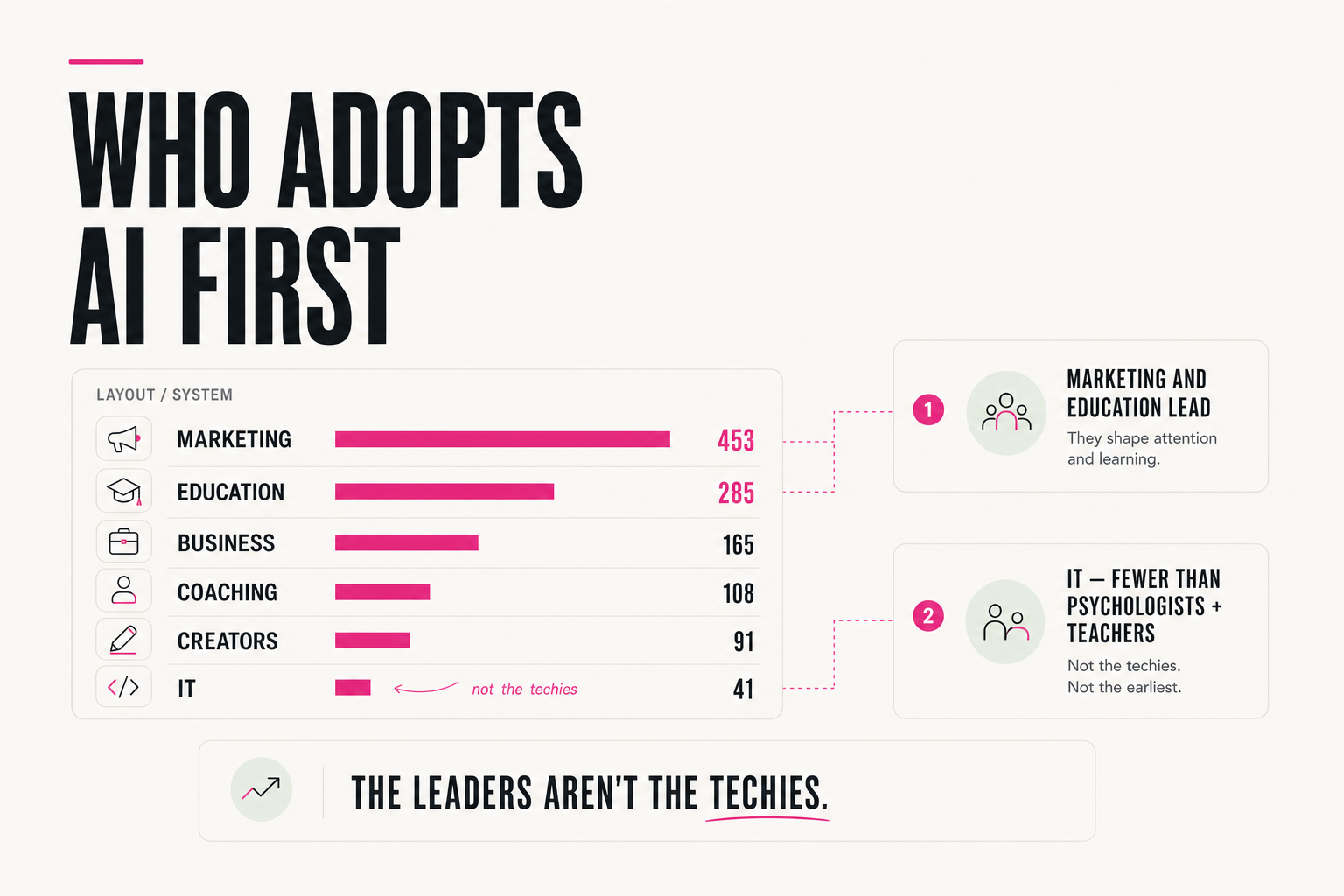
The stereotype: techies adopt AI. The data says otherwise. By niche tags, the leaders are marketing (453 cases), education (285), business owners (165), coaches (108), creators (91). IT people — just 41, fewer than psychologists and educators combined.
The logic is simple: the first to come aren't those who can code but those whose routine eats their expert time — content, teaching materials, client analysis. In one cohort a tarot reader, a lawyer, an ophthalmologist, an HR partner and a Wildberries seller sit side by side — and they turn out to have the same tasks. Different niches, one request: "hand off the routine, keep the essence."
A tarot reader puts AI off for months: "I don't have a business, I don't do marketing — this isn't for me."
Types the exact same request as the marketer next to her: "take the post-writing off my plate." The niche doesn't matter — the routine does.
03 — What
What do people delegate first?
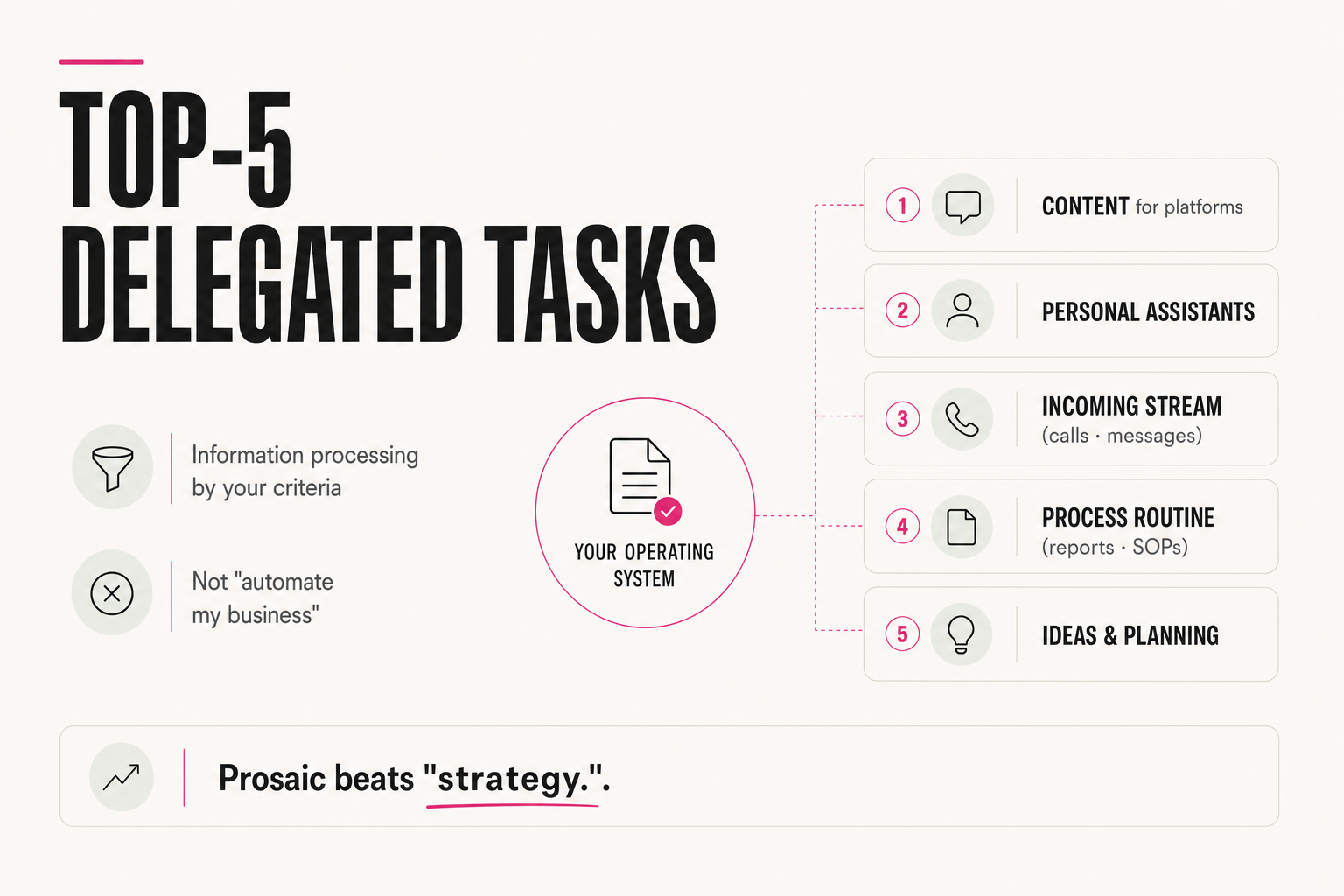
Not "strategy" and not "automate my business." The top requests, in their own words, are more prosaic and more concrete:
- Content for several platforms at once — "offload writing posts and Reels so I can consistently publish to 3 platforms";
- Personal assistants — "build assistants that write in my style," "digitize my thinking";
- Processing the incoming stream — "most of my time goes to listening to and checking calls and messages — that's what I want to delegate first";
- Process routine — reports, meeting transcriptions, follow-up emails, SOPs;
- Ideas and planning — a content plan that "never runs out."
Notice: almost all of this is information processing by one's own criteria, not unique judgment. Exactly what AI does best.
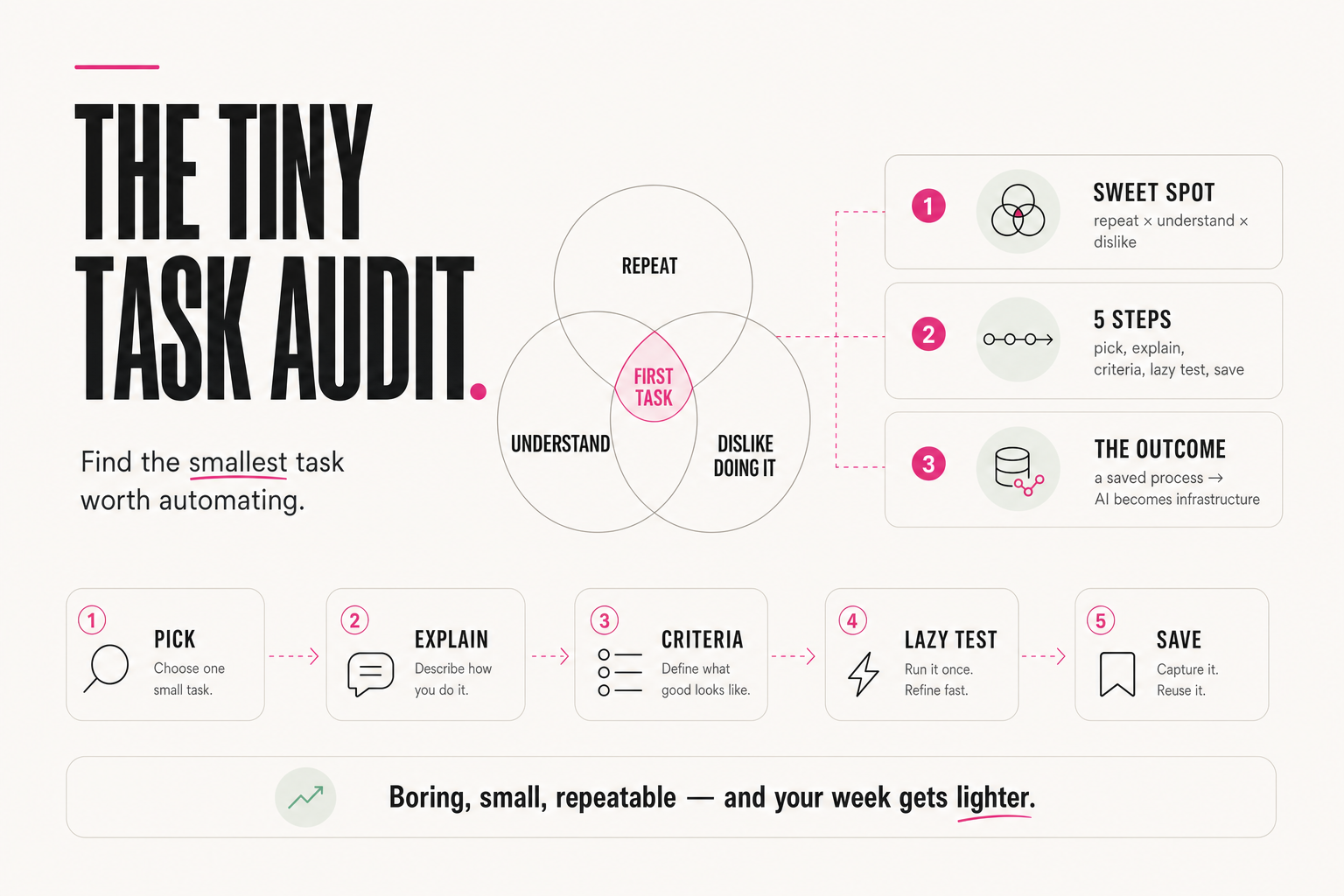
Here are my recurring tasks this week: [list 5-7].
For each, answer:
1) How many minutes a week does it eat?
2) Does this need my unique judgment, or is it information
   processing by criteria I already know?
3) Do I have 3 examples of me doing this well?
Sort by (time × "yes" on 2 and 3) — that's your first target.
04 — Where they stall
Why do some take off while others get stuck?
The most stable pattern in the base: people don't stall because of tools. Everyone has the same ChatGPT — and radically different results. The difference comes down to three things:
- Undigitized expertise. "I know how it should be done but can't explain it to the machine" — the most common blocker. While the method lives in your head, the assistant returns the average.
- Starting too big. Those who start with "automate everything" burn out on setup. Those who start with one boring task have a system within weeks.
- No habit of saving. A working prompt stays in chat history — and the process gets reinvented from scratch.
This is exactly the "foundation" without which agents don't work: task analysis, breaking work into steps, digitizing expertise. The tools are identical for everyone — the foundation is not.
Answer yes/no:
1) Can I explain my method in steps, not just "I feel it"?
2) Is my first AI task under 30 minutes a week?
3) Do I save working prompts anywhere besides chat history?

0-1 "yes": start with #1 — digitize your method on one example
2 "yes": narrow the task down to one, the most boring one
3 "yes": you're not stuck anymore — keep building the system
05 — Speed
How fast is the path from zero, really?
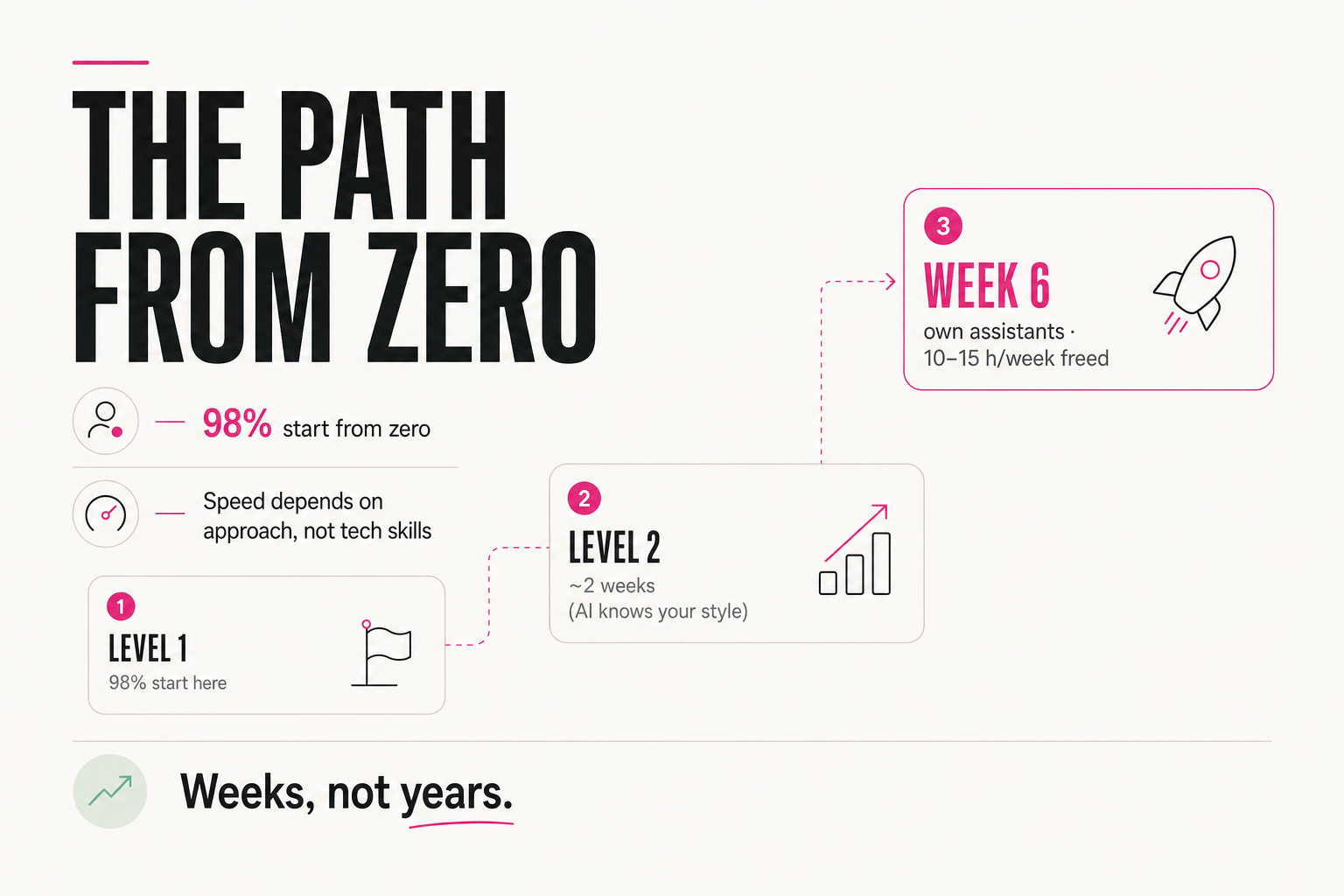
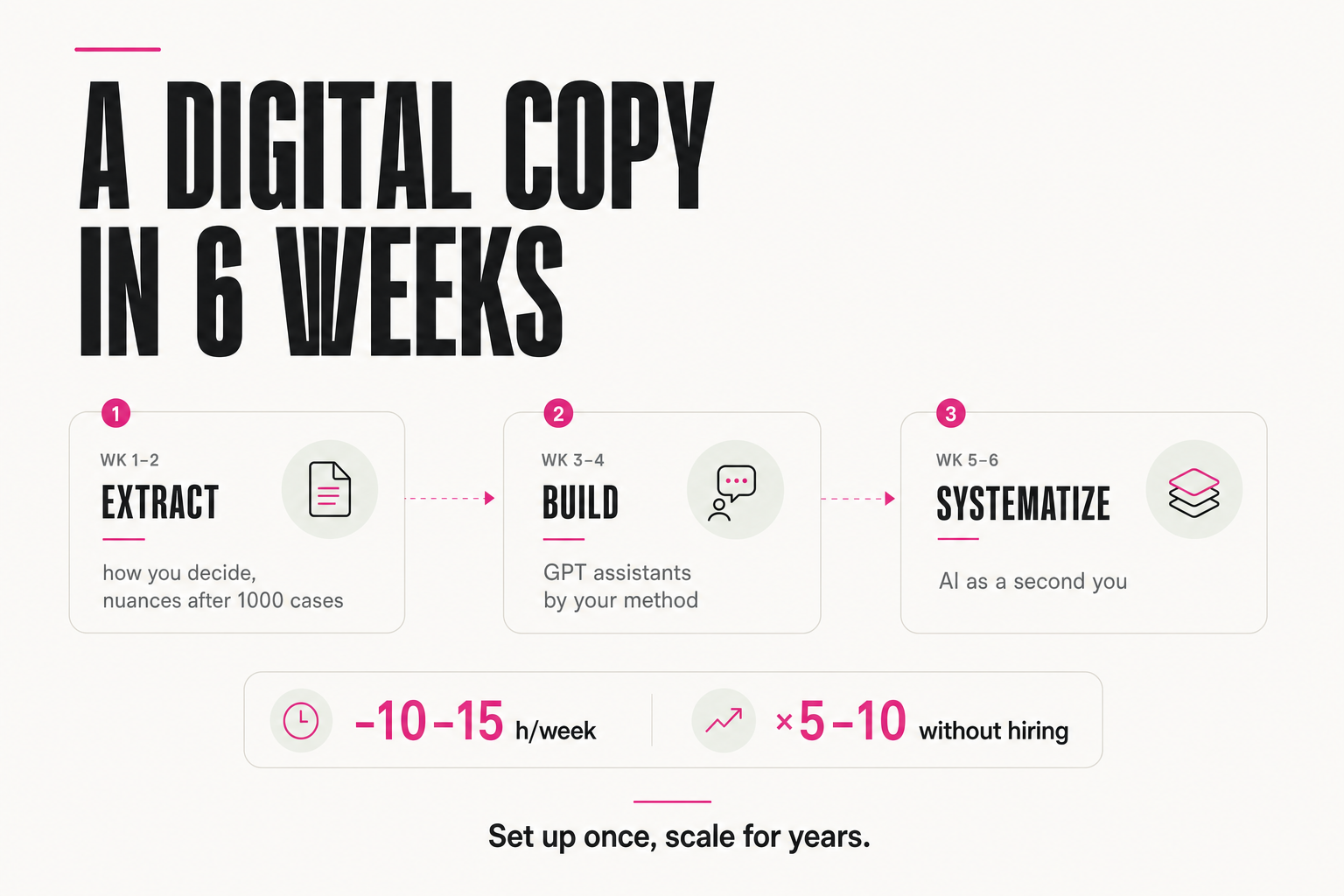
The good news from the base: the path is shorter than it looks. At the start of a cohort about 98% of participants are at level one ("I open ChatGPT, ask for a post, rewrite it"). Within two weeks most move to level two — AI already knows their style and context. By the end of 6 weeks many have built their own assistants and digitized their method — the "digital version" that frees 10–15 hours a week.
The key finding: speed barely depends on how technical you are. Linguists and tarot readers walk the path the same way marketers do. What it depends on is whether you start with small tasks and transfer your context — or hunt for a magic prompt.
Once a week, mark honestly:
Level 1 — I ask for the whole result, then rewrite it myself
Level 2 — I give my style/context, edits are point-fixes
Level 3 — I have a ready assistant/template for the task

No movement for 2+ weeks? The task was too big.
Step back and cut it to half the size.
06 — What to do with this
Which takeaways should you keep?
1. You're not late: almost everyone starts from zero — and catches up in weeks
2. Start with content/routine, not with "strategy"
3. The difference isn't the tool — it's digitized expertise
4. One small task → a system; "automate everything" → burnout
5. Save working processes — or you'll reinvent them from scratch800+ cases converge on one thing: AI is adopted successfully not by the most technical people, but by those who honestly mapped their routine and transferred their context. Everything else is tool details that change every month.
FAQ
Where do these 800+ cases come from?
From the private chats of many AI focus-group cohorts: registration requests, tasks in progress, and results over 6 weeks. It's behavioral data, not a survey. Cases are only published anonymized — "a psychologist from the focus group," no names or identifying details.
Which niches adopt AI most actively?
By the base's tags: marketing (453 cases), education (285), business (165), coaching (108) and creators (91) lead. IT is notably smaller (41). One case can belong to several niches, so the numbers show relative weight rather than strict shares.
What do people delegate to AI first?
Content for several platforms, building personal assistants, processing the incoming stream (calls, messages), process routine (reports, transcriptions, SOPs) and idea planning. Almost all of it is information processing by one's own criteria, not unique judgment.
How long does the path from zero to working assistants take?
Per the cohorts: ~98% start at level one ("ask for a post — rewrite it"), move to level two within two weeks, and by the end of six weeks many have built assistants and digitized a method that frees 10–15 hours a week. Speed depends on approach, not technical background.