AI for lawyers: how legal work becomes parametrized
An attorney leading a team of 11 lawyers works with AI daily. What actually gets delegated — template document work, inquiry flow, monitoring — and what never does.

01 — The stereotype
Why is "lawyers can't use AI" a myth?
The stereotype: law is too high-stakes for AI. The reality from the base: an attorney managing a team of 11 lawyers uses ChatGPT, Claude, Perplexity and NotebookLM daily — not as an experiment but as a working pipeline.
The resolution: legal work has two layers. The top layer is judgment — strategy, court, liability. The bottom is a huge volume of structured text by rules: contracts, inquiries, letters, monitoring. The bottom layer parametrizes perfectly — and that's the layer AI takes.
Task: [describe it].
Ask: 1) Does this need a position/strategy I'm personally
accountable for? Or 2) is it structured text by rules where I
already know the format and criteria?
(1) → do it yourself, AI assists. (2) → hand AI the draft.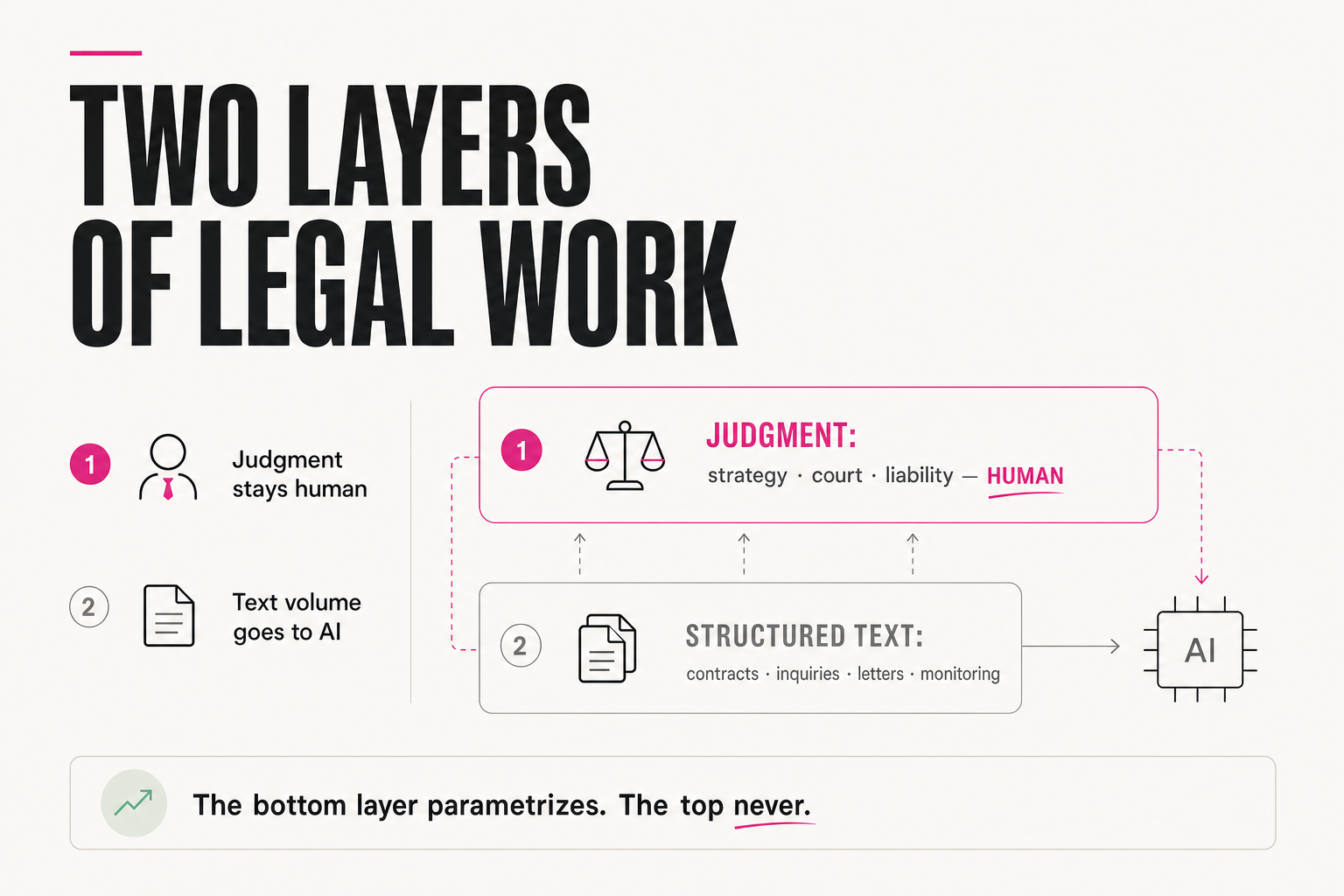
02 — The formula
"Context and meaning → a document from a template": how does it work?
The exact phrasing from the case: the lawyer "sets the context and the meaning, getting worked-through material from a template." Unpacked:
- The template — a document structure formalized once: sections, mandatory clauses, the firm's style;
- The context — the specifics of the matter: parties, subject, particulars;
- The meaning — what the lawyer wants: emphases, risks, position.
AI assembles the third from the first two — the lawyer reviews and signs. This isn't "AI writes contracts instead of the lawyer" — it's a typography of meaning: the routine of typesetting text disappears, the expert decision stays.
Template: [document structure, mandatory sections, firm style].
Case context: [parties, subject, particulars — anonymized].
Meaning: [what to emphasize, which risks to highlight,
what position].
Assemble a document draft from the template, weave the context
and meaning into the right sections. Flag spots that need my review.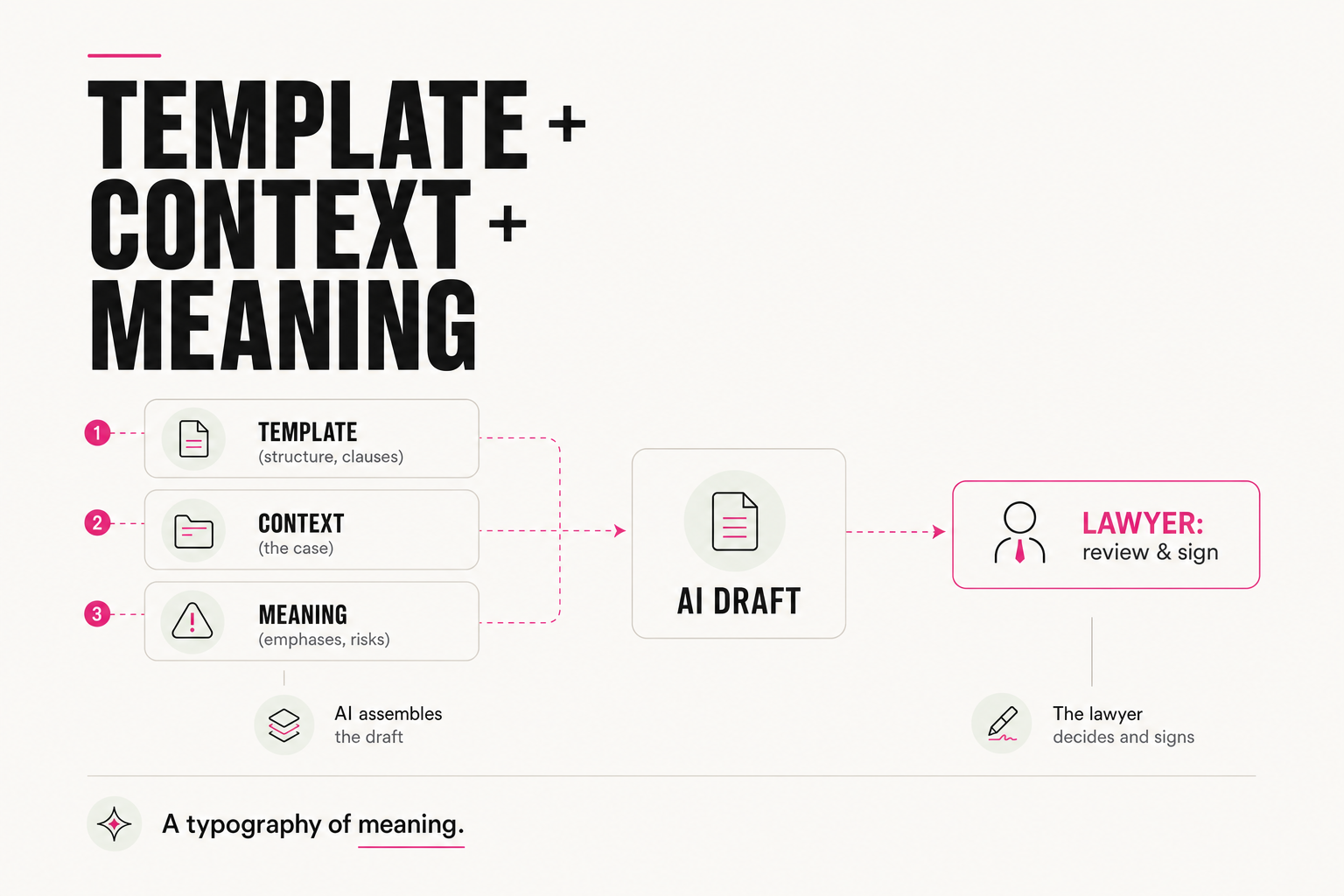
03 — The flow
How do you process inquiries and contracts in batches?
The case's second pattern is batch processing: client inquiries and contracts get analyzed not one by one but as a stream. Inquiries are classified and receive draft replies; contracts pass a mass check for standard risks before a lawyer touches them.
A related move from an adjacent case: contract review is delegated to junior staff armed with GPT — they run documents through the SOP, and the senior lawyer looks only at the flags. The team processes more without growing headcount — the bottleneck stops being the partner's hours.
Here are 20 incoming client inquiries: [paste, anonymized].
For each, determine: 1) category (standard / needs a lawyer now),
2) a draft first reply for the standard ones,
3) which 2-3 inquiries need the partner's attention immediately.
04 — Monitoring
What else: competitors, practice, content
Also from the case — competitor monitoring by AI: who publishes what, where the market stands, what's shifting in practice. Perplexity and NotebookLM work as a research department here: one searches, the other holds the document base and answers from it.
And content: lawyers complain that "content doesn't move" — dry posts about statutes go unread. The fix is the same as in other niches: write from real cases in the client's language, with AI repackaging expertise into human formats. The lawyer who explains clearly beats the lawyer who quotes the code.
"Per Section 123 of the Civil Code, a contract must contain material terms" — only another lawyer reads this.
"A client signed a contract missing one clause — it cost them $4,000. Here's what to check before you sign" — a client reads this.
05 — The limits
What does a lawyer never hand to AI?
The boundaries in this profession are harder than anywhere:
- Confidentiality. Client data doesn't go into public models without anonymization — that's a professional duty, not a preference;
- Verifying every citation. AI can confidently invent case numbers and statutes — every reference gets checked against the primary source;
- Judgment and liability. Strategy, court, signature — human only. AI prepares the material; the lawyer answers for it.
The work runs on "AI drafts, the lawyer finalizes." That's exactly why it's safe: the machine speeds up the typesetting, not the decision.
☐ Every reference to a statute/case verified against the primary source
☐ No client data in the text that wasn't anonymized
☐ The position/strategy was reviewed and signed by a lawyer, not AI
☐ If a public model was used — no sensitive details in the document
  that shouldn't have been pasted in in the first place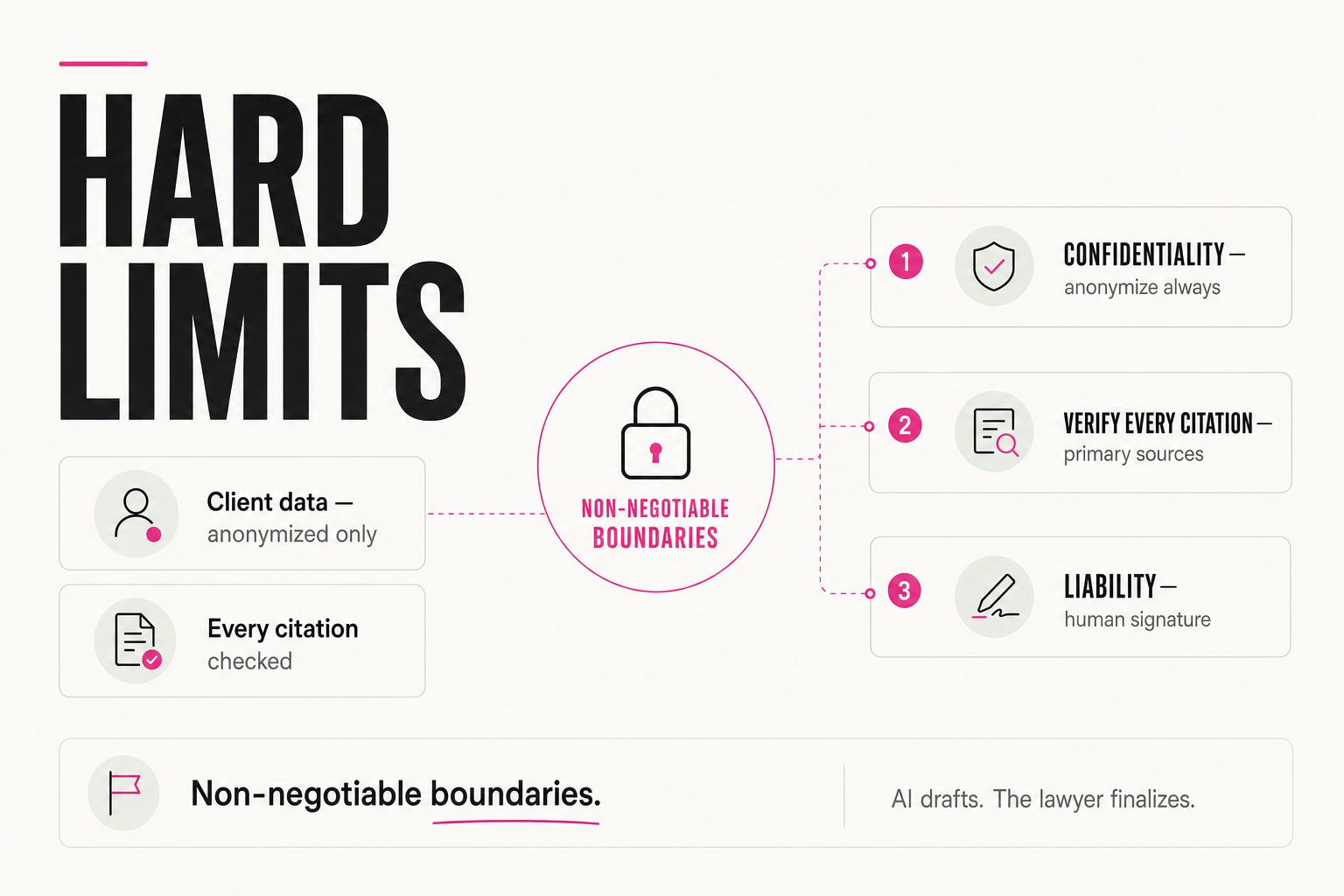
06 — Where to start
Where should a lawyer start this week?
1. Take the one standard document you produce most often
2. Formalize its template: structure, mandatory clauses, style
3. Prompt: "here's the template, here are the case inputs
   [anonymized], here are the emphases — assemble a draft"
4. Review everything; corrections → add as rules to the template
5. Forever rules: client data only anonymized, every legal
citation verified against the primary sourceLegal work parametrizes: template + context + meaning = a worked-through draft. AI takes the typesetting and the flow; the lawyer keeps judgment, court and the signature. The boundaries — confidentiality and source verification — are non-negotiable.
FAQ
Can a lawyer upload client documents to ChatGPT?
Only anonymized — confidentiality here is a professional duty, not a preference. The working scheme from the cases: templates and SOPs carry the structure and style, while a specific matter's inputs go in without identifying data. For sensitive volumes — enterprise solutions with data controls.
Won't AI invent non-existent statutes and cases?
It can — confidently and plausibly. Hence the practice rule: every reference to a statute or case is verified against the primary source before it enters a document. AI serves as a generator of drafts and template-based analyses, not as a source of legal positions.
What should a lawyer delegate first?
The most frequent standard document: formalize its template (structure, clauses, style) and assemble drafts by the formula "template + anonymized inputs + emphases." Per the case of the attorney with a team of 11, batch inquiry processing and competitor monitoring come next.
What tools do the lawyers in the cases use?
The daily stack from the case: ChatGPT and Claude for template-based text work, Perplexity for search and monitoring, NotebookLM as a document base that answers from uploaded materials. The point isn't the specific names but the combination: generation + search + your own knowledge base.