5 tasks stealing an hour a day from you — hand them to AI
It's not big projects that eat you — it's the small stuff. Here are five recurring time-thieves and how to offload each to an assistant.

01 — The truth
Where does your time actually leak?
Most people think they have no time for big projects and deep work. But honestly, the time doesn't leak into strategy — it leaks into small stuff. The trifles that barely count as work yet take an hour every day.
We're convinced big things eat us, while we actually drown in the small ones. And break down that hour and it's always the same recurring actions. The good news: recurring is exactly what offloads best to AI. Here are the five sneakiest thieves.
At day's end, log every task over 10 minutes and its time.
Mark ✓ the ones that repeated almost verbatim last week.
Add up the time on "✓" tasks — that's your real time-thief,
not whatever feels important in the moment.
02 — Thieves 1–2
Meeting prep and digesting incoming — why are they a bottomless pit?
1. Prepping for meetings. The real work starts before the call: forms, notes, past threads, the client's inputs. You review it all, pull out what matters, plan questions — and at some point prep takes longer than the consultation itself. You can't skip it, or the meeting is raw.
2. Digesting briefs and incoming info. They send you 10 pages, dozens of screenshots, a 20-minute voice note — and it's all "important." You sit and sort signal from noise, churning through piles for a couple of insights.
Both are compressing someone else's information into the essence. Exactly what AI does fast: give it the inputs and your criteria for "what matters to me" and get a meeting brief and a digest in minutes, not an hour.
Here are the client inputs: [form/thread/notes].
What matters to me: [2-3 criteria, e.g. "risks," "past promises"].
Build a brief: 5 key facts, 3 questions worth asking, and
1 risk that's easy to miss.
03 — Thief 3
Why does structuring ideas eat the most?
3. Structuring ideas and material. An expert is always overflowing with ideas, notes, links. To turn notes into a method, thoughts into a program, fragments into an article, you have to sit and lay it out. And here a ton of time disappears: the brain doesn't want to stop and structure, it wants to run on and invent.
This is the perfect task for AI: you dump the raw material as-is — by voice, in bullets, in fragments — and it assembles the structure to your template. You stay the idea generator and hand off the boring assembly.
Here's a transcript of me explaining [method/idea]: [paste it].
Assemble it into a structure by template: a title, 3-5 sections,
a conclusion at the end. Keep my order of thoughts and phrasing —
don't rewrite in your own words where the meaning is already clear.
We spend months of our lives not on expertise or growth but on small stuff that hands off easily to an assistant.— Anjela Petkova
04 — Thieves 4–5
Feedback and documents — why does the expert do them alone?
4. Feedback. Edits, explanations, comments for team and clients. You write long messages, choosing words to land the point without offending. Sometimes it's easier to do it yourself than spend an hour explaining.
5. Documents and systematization. Guides, instructions, specs, checklists — the bedrock. Without them the team gets confused and clients get lost. And most often it's the expert who sits and writes them.
Both are translating your knowledge into a form others understand. An AI assistant with your criteria writes feedback in your tone and assembles an SOP from a rough explanation — and you just check it.
Here are my feedback bullets (short, as-is): [paste them].
Expand into a message for [colleague/client]: kind but direct,
not softened past recognition. Start with what worked, then
what to fix, specific and itemized.
05 — The pattern
What do all five share — and why can you offload them?
Notice the pattern: all five aren't unique expert judgment but processing information by your criteria: compress, structure, translate into a format. That's exactly what AI does fast and consistently, once you hand it your criteria and style.
5 tasks × ~1 hour a day = nearly a full workday a week on routine.
You give inputs → the assistant prepares → you check. The hour shrinks to minutes.
I'm genuinely lazy: my knowledge has long been digitized into assistants, and they do the routine. It's not magic — it's transferring the repeatable once.
06 — Where to start
Which thief do you offload first?
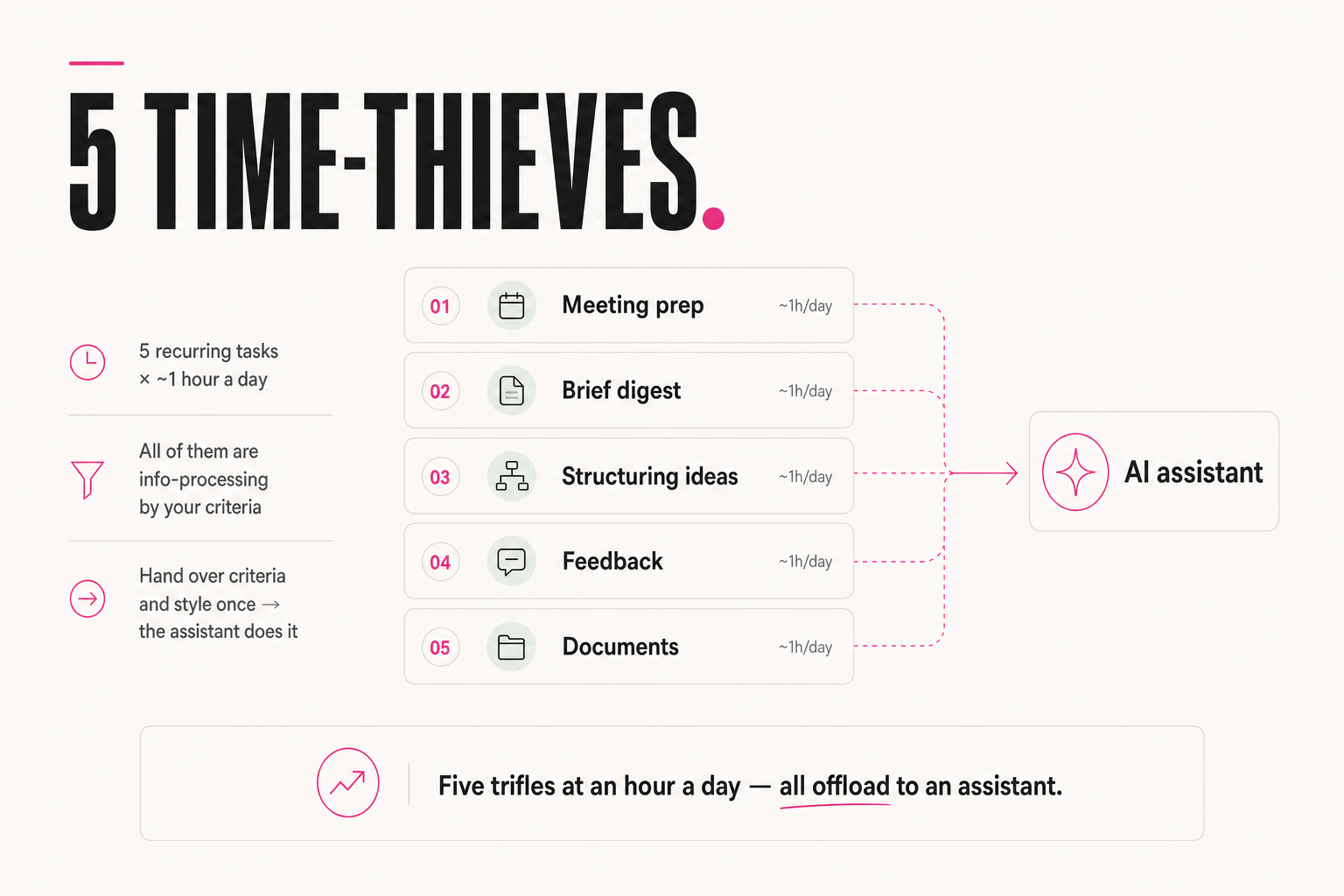
Don't try to offload everything at once. Take the thief that steals the most and build one assistant for it:
1. Meeting prep   → assistant: inputs + "what matters to me" → brief
2. Brief digest   → essence from 10 pages in minutes
3. Structuring    → voice draft → structure to your template
4. Feedback       → bullets → feedback in your tone
5. Documents      → an explanation → a finished SOP/spec
One assistant, one thief, a week to settle — then the next. That's how five hours a week come back to you, with no heroics and no big projects.
FAQ
Why is it small stuff, not big tasks, that steals time?
Because big tasks are visible and we plan them, while small stuff slips by "in passing" and doesn't count as work. But it recurs every day for an hour: meeting prep, digesting incoming, structuring, feedback, documents. Add it up and it's nearly a full workday a week.
Can these really be handed to AI without losing quality?
Yes, because all five are processing information by your criteria, not unique judgment. Hand the assistant your criteria and style once, and it compresses, structures and translates into format while you just check. You keep the unique parts — strategy, hard calls — for yourself.
Where do I start so I don't drown in setup?
With one thief — the one stealing the most time. Build one assistant for it, run it for a week, then move to the next. Don't try to automate all five at once: one working assistant beats five half-configured ones.
Why is an assistant better than just googling prompts?
Because your criteria, tone and format are baked into it once — it doesn't start from scratch each time. A one-off prompt solves a task once; an assistant with your context solves it consistently and in your style again and again.