You don't need another hire. You need a system
Adding people scales your costs faster than your output. Here's how to turn a task you repeat into a system that runs itself.

01 — The reflex
Why does hiring feel like the answer — and rarely is?
You're overloaded, so you add a person. It helps for a month. Then you notice you're now writing briefs, answering questions, reviewing their work, and fixing the misunderstandings. Your output went up a little; your coordination went up a lot.
Every hire scales two things: capacity and overhead. For repetitive, well-defined work, the overhead often eats the gain. The bottleneck doesn't disappear — it moves to you, the manager. You wanted to offload work and ended up with a second job: managing.
Do the honest math. You hire a content person: week one is onboarding, then every piece is a brief (twenty minutes), a review and edits (half an hour), plus calls and answering questions. It adds up to a day or a day and a half of your week — spent managing one person. The output goes up, but the slice of time you wanted to free now goes into getting that person to deliver. This isn't an argument against people — it's an argument for first asking: could this task simply not need re-explaining every time?
Onboarding: 1 week
Per piece: a 20-min brief + a 30-min review and edits
Calls and questions: ~1-2 hours a week
Total: 1-1.5 days of your week spent managing ONE person

If the task is repeatable and well-defined, it's a candidate
for a system, not a hire.
02 — The shift
What's the difference between a person and a system?
A person does the task. A system encodes it. When you hire, the know-how lives in someone's head and leaves when they do. When you build a system, the know-how lives in a process you own — and it runs the same way every time.
This is why a small operator with good systems often outproduces a bigger team without them. They've turned repeatable work into something that doesn't need re-explaining.
A new hire learns your process once. A system is your process — and it never forgets it.— Anjela Petkova
You feel it most sharply when someone leaves. A strong specialist spent six months holding in their head how you run email — the tone, the segments, what you never say. They quit, and all of it walks out with them: the next person starts from zero and you explain it all again. A system can't leave like that. The process you wrote down stays — the next person inherits it, and so does the AI. You're building an asset, not renting someone's memory.
1. Is the tone, segmentation and rules for this task written down
   anywhere — or does it all live in one person's head?
2. If they quit tomorrow, could a new hire handle it in a day,
   or would it take a month to learn?
"In their head" / "a month"? That's not a system — it's dependency
on one person. Write the process down today, not after they leave.
03 — The method
How do you turn a repeated task into a system?
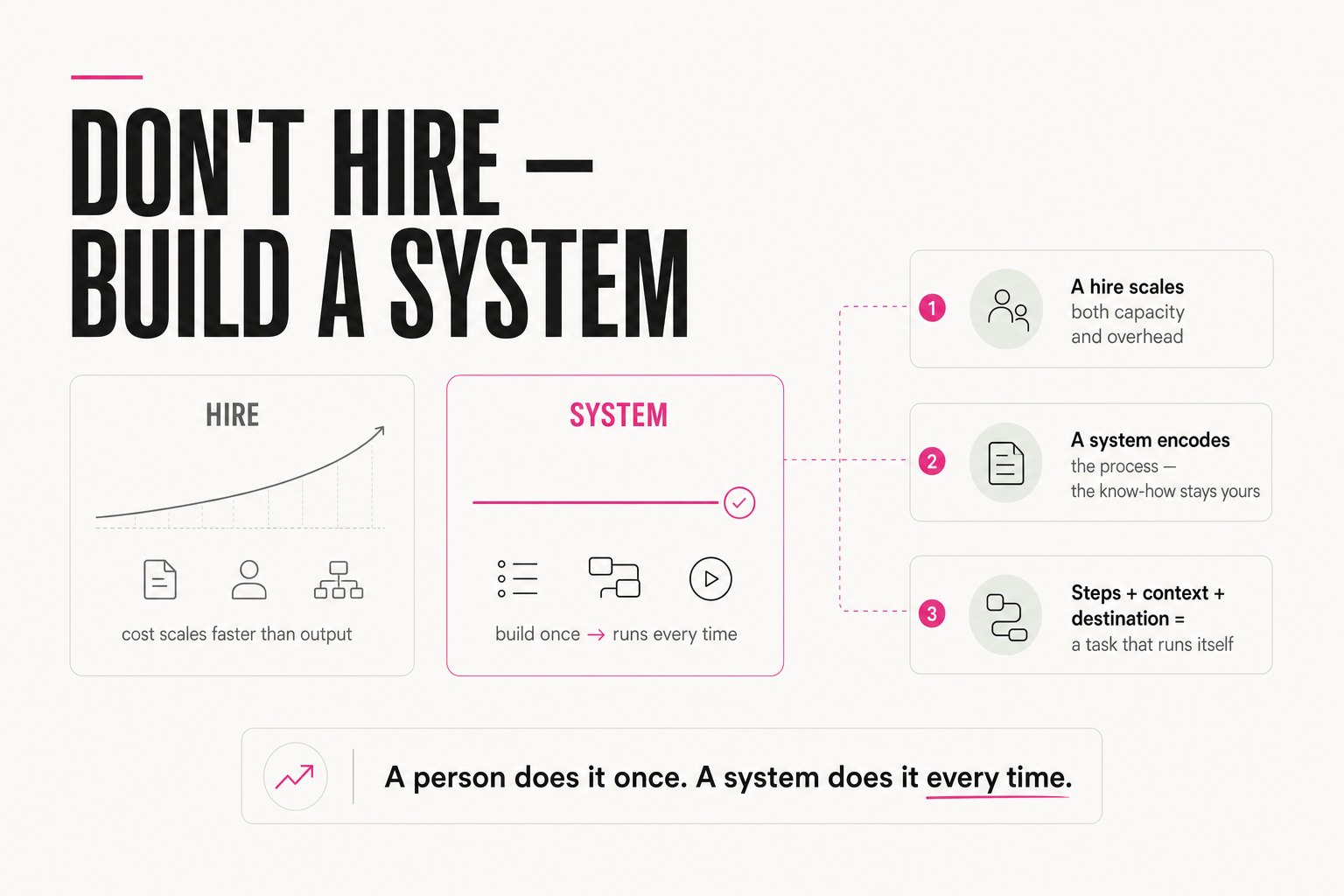
Pick one task you do over and over. Then make it runnable by AI:
- Write the steps. Describe how you actually do it, in order — the checks, the decisions, the order of operations.
- Give it context. Who it's for, your standards, what to avoid.
- Give it a destination. Where the result goes — a doc, a draft, a channel — so output becomes a finished thing, not a chat message.
Here's what that looks like on one task — the weekly client report you used to assemble by hand in an hour:
Steps:   pull the numbers from the sheet → compare to last week →
         surface the 3 biggest shifts → assemble into the report format
Context: B2B client, likes it dry and to the point, no fluff; standard —
         every takeaway has a number and one recommendation
Dest:    a Google Doc draft "Report {client} {date}" for your review
Build it once and the report shows up on its own, in one format, every week. You just check and send. That's the difference: not "an assistant I re-explain the report to each time," but a process that already knows how it's done.
Before you add a person, ask: is this task repeatable and well-defined? If yes, it's a system, not a hire. Save the people for the work only people can do.
04 — What to systemize
Which tasks should a system take first?
The frequent and well-defined ones. The list of what genuinely delegates today is longer than people think:
- audience analysis & competitor analysis
- content plans for different goals (personal / expert / pain-based)
- headlines, offers, triggers; sales-page structure
- product and service descriptions
- reel ideas and their hooks; warm-up sequences
- business processes, SOPs, specs
- site structure and copy
- building GPTs and their instructions
Each of these is repeatable with a clear sense of "good." You open a ready algorithm, take it, and solve the task in 10–15 minutes — no waiting for a live call. Leave people the work that needs fresh judgment or real relationships. The formula is simple: frequency × clarity = a good first system.
05 — The trap
Why is "beautiful automation" not yet a system?
Beware the showroom. Marketers shout "build an AI agent in 1 minute," "automate everything" — it's a magic pill, entertainment for clever people. Plenty of folks build beautiful automations: impressive, and not effective at all. To make it effective you have to spend hours on business analysis and think through every micro-detail of the process — and only then automate.
What the popular videos never mention: cost, feasibility, expected metrics. Without those, automation easily becomes an expensive void:
We automated content. Reach was 0. It stayed 0 — but now it ships 100 pieces of AI content a day, plus a pile of costs.
First the question: which number are we moving? Then a process built for it. Less output in units, more in result.
A system that doesn't know which metric it moves isn't a system — it's a shiny wrapper. Metric first, automation second.
06 — The limit
When do you still need a human?
Systems win at the repeatable. Humans win at everything else: judgment calls, relationships, taste, and the genuinely new — work where the right answer isn't defined yet.
Honestly, about myself: even with a large audience across channels, we keep people — freelancers who do parts of the work by hand. It looks far less impressive than "all AI." But it's effective. Flashy and effective are different things, and the second one matters more.
So the move isn't "never hire." It's: automate the repeatable so your people spend their time where humans are irreplaceable. You don't shrink the team. You stop wasting it on work a system should have owned.
Task: [describe it].
1) Is there one clear right answer here, or is it different
   every time?
2) Does this need relationships (trust, live contact), not just
   an output?
3) Is this the first time you're doing this, or the hundredth?
One answer/first time/relationships → human. Clear/repeatable → system.
FAQ
Isn't building a system harder than just hiring?
Upfront, a little. But you build it once and it runs forever, while a hire needs onboarding, management and replacement. For anything you repeat, the system pays back fast — and it doesn't quit.
What tasks should I systemize first?
The ones that are frequent and well-defined: the same report, the same content format, the same intake. Leave anything that needs fresh judgment or human relationships to people. Frequency plus clarity equals a good first system.
Doesn't this mean firing people?
No. It means stopping people from spending their hours on repetitive work a system should own, so their time goes to judgment, strategy and relationships — the work that actually needs them.
How do I know automation is even worth it?
By the metric. Before you build, answer: which number does this move, and what does it cost? If automation produces more units but doesn't move the result, it's an expensive wrapper. Metric and feasibility first — process second.