In life you're a complex person. In your blog — "expert, loves coffee." An AI personality unpacking
A two-board scheme: "What I'm made of" and "How my different sides can live in one blog." With the full adaptive-interview prompt — business is just one facet here.

01 — The problem
Why does a blog shrink to "the expert" when you're more than that?
We've already used ChatGPT on the face, hair, makeup and wardrobe. Now I decided to unpack the thing invisible in any photo. Myself 😁
In life you're a complex person. Dozens of interests, abandoned hobbies, contradictions, stories. But only "expert in X" makes it into the blog. Maybe "loves coffee and travel" in the bio. That's all.
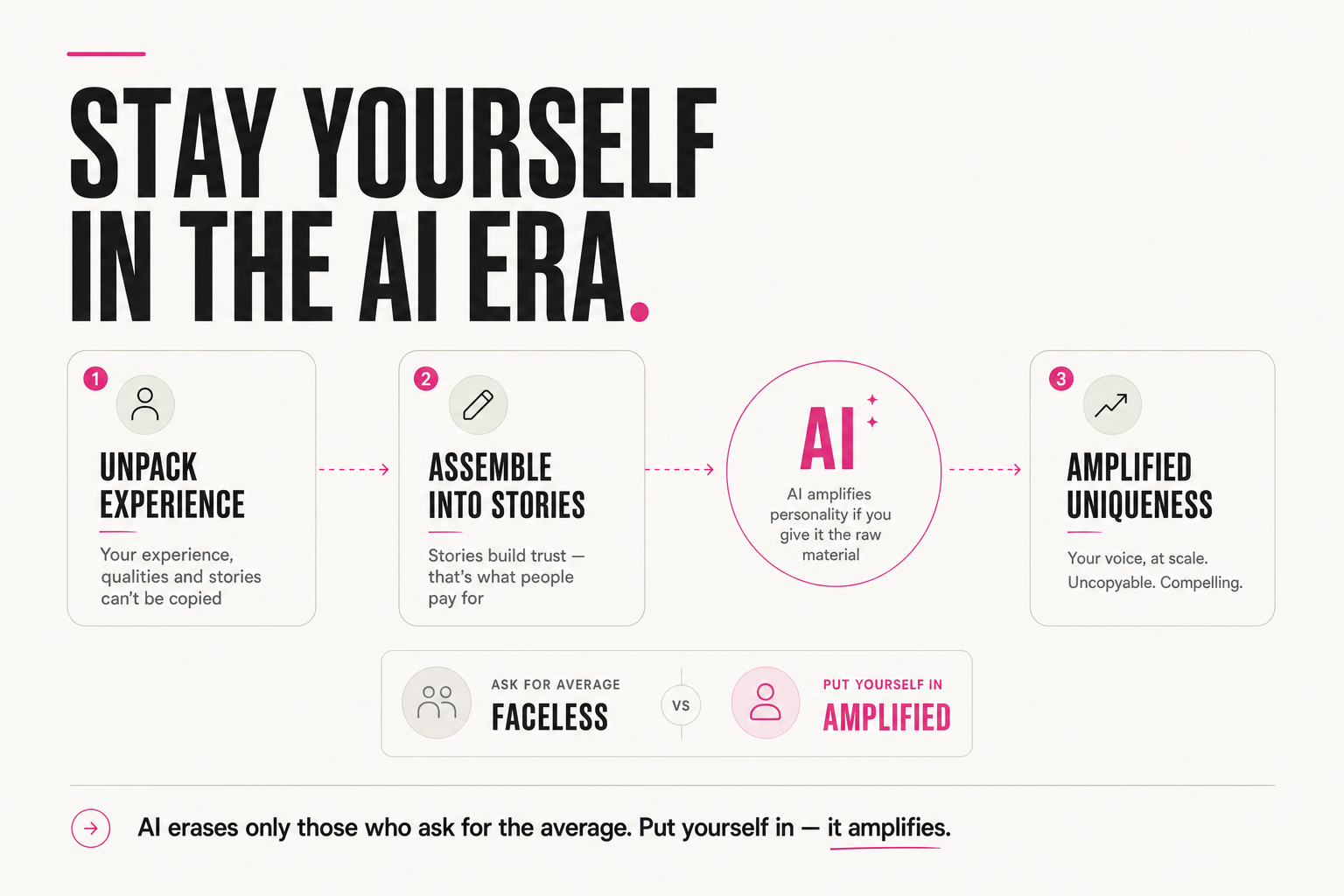
Except people don't subscribe to your credentials. They stay with a person they're getting to know: through details, tastes, incompatible sides. Expertise brings the follower; personality keeps them. And the problem isn't that the personality is missing — it's that you can't see it from inside: to you it all looks like "just ordinary life."
02 — The scheme
How does the two-board unpacking work?
I built a scheme that doesn't just hand you "the Sage archetype." It works in two stages:
- Stage 1 — an adaptive interview. ChatGPT asks: what you do when there's nothing to prove; which topics you fall down rabbit holes on; which hobbies you dropped; what you dream of trying someday; which of your sides seem incompatible. Work is just one facet — and its question comes near the end.
- Stage 2 — two boards. From your answers it assembles: the "What I'm made of" board — current and forgotten hobbies, rabbit-hole topics, roles, tastes, habits, the details people recognize you by; and the "How it all fits in one blog" board — recipes for mixing the sides.
hobby × another hobby      → "what ceramics and prompts share"
interest × life situation  → "a move, seen by a collector"
taste × observation        → "why I choose places like this"
hobby × expertise (rarely!) → "what running taught me about work"
Notice: "hobby × expertise" is marked "rarely." Chain every facet of your personality to work and the blog becomes a business scheme again — just with a human face.
03 — The prompt
What does the adaptive-interview prompt look like?
Stage one's prompt, in full — take it:
You are an attentive interviewer. Your task is to help me see the
different parts my life is made of: what I love, what I'm into,
what I keep returning to, what energizes me, and how these sides
can naturally show up in my blog. Do not reduce me to a profession,
a business, or a "personal brand." Work is only one side of my life.

Run an adaptive interview with me.

Interview rules:
— ask strictly one question at a time;
— ask 10–12 substantial questions; don't turn it into an
  interrogation;
— if I answer abstractly ("I love freedom," "growth matters to
  me"), don't accept it — ask for a concrete situation, choice,
  action or detail;
— look for tensions, not just strengths: "I love X, but Y,"
  "people think X about me, but actually Y";
— no diagnoses; don't ascribe motives without evidence;
— the main focus is interests, passions and real life — not career.

Be sure to ask:
1. What I love doing when there's nothing to prove and no utility.
2. My current hobbies — regular and occasional.
3. What I used to be into but dropped, and what I'd return to.
4. Which new pursuits and worlds I dream of trying.
5. Which topics I fall into: what I read, watch, save, discuss.
6. Which places, people, music, food, aesthetics keep pulling me.
7. What my ordinary day looks like and its small rituals.
8. My roles outside work: friend, partner, parent, collector…
9. Which of my sides seem incompatible yet are equally mine.
10. What I already show in the blog, want to show, or keep private.
11. What I do professionally and how much space work really takes
    in my life. Ask this near the end.

When you have enough, say: "I have enough material. Assembling
your personality and interests map" — and create the dossier:
1. "My universe": 6–8 equal sides of me (work may be one of them,
   but never the automatic center).
2. "The passions map": current hobbies / occasional / forgotten /
   rabbit-hole topics / "someday I'll try."
Three rules inside make it stronger than a generic "unpacking": refusing abstract answers, hunting for tensions ("I love X, but Y"), and placing the work question last so it can't eat the interview.
04 — The guide
How do you go from the interview to content ideas?
Send the prompt from section 03 and answer one question at a time — voice answers come out livelier. Don't polish: "I binge furniture-restoration videos" is worth more than "I'm interested in design."
After the dossier, request board two: "Now show how my different sides can live in one blog: suggest combinations of hobby × hobby, interest × situation, taste × observation, and only occasionally hobby × expertise." You get a mixing map built on your material.
A good unpacking triggers "oh, that's really me" — incompatible sides included. If the board reads like someone else's polished profile, push back: "too smooth — bring back my contradictions and oddities from the answers."
The final prompt: "Based on my map, suggest 10 post ideas where expertise appears in at most three." You get a content plan that contains you — not only your job.
Interview question 10 isn't a formality: consciously choose which facets are public. A living blog ≠ a transparent aquarium; boundaries are what make openness sustainable.
05 — The practice
What is your blog missing right now?
A quick self-diagnosis on your blog's last 10 posts:
06 — The point
What changes when you appear in your blog?
The unpacking isn't "finding your archetype" and isn't a marketing trick. It's a way to see yourself from outside: what you're actually made of — and how much of that richness hides behind the door labeled "expert."
When your real facets enter the blog, a quiet but important replacement happens: followers become people who recognize you. And recognition is what loyalty, trust and — ultimately — sales stand on, without a single "warm-up funnel."
Expertise attracts → personality retains
Board 1: what I'm made of (6–8 facets; work is one of them)
Board 2: how facets combine (hobby × hobby, taste × observation…)
Ratio: expertise ≤ 1/3 of content — the rest is alivePeople stay with a person they recognize — not with a list of credentials. The adaptive-interview prompt assembles your map in an evening: 6–8 facets, forgotten hobbies, incompatible sides — and recipes for letting them live in one blog. Start with the interview — and see how much of you turns out to be behind the "expert" label.
FAQ
How is this different from a regular "expertise unpacking"?
The direction: an expertise unpacking hunts for what to sell and reduces you to a profession. Here work is one facet of 6–8, its question comes last, and the focus is hobbies, rabbit-hole topics, roles and contradictions. The result is a living person's blog, not a business scheme with a human face.
What if my answers come out abstract?
The prompt fights that itself: its rules forbid accepting "I love freedom" as an answer — the model will ask for a concrete situation or detail. Help it: give scenes instead of categories ("binged a dresser-restoration video") — recognizability is built from details.
Won't personal content damage my expert image?
The opposite — at the right ratio: the expertise stays, and a trustworthy person appears next to it. The scheme's guide: "hobby × expertise" only occasionally, not in every post. And interview question 10 explicitly helps you decide what stays private.
How do I turn the personality map into a content plan?
With the final prompt: "based on the map, suggest 10 post ideas where expertise appears in at most three." Plus the second board's mixing recipes: hobby × hobby, interest × life situation, taste × observation. That covers weeks of content that actually contains you.