I expected video to win. Over 750,000 followers, about 78% of them on Threads
Most experts think growth starts with a camera. My numbers said otherwise. Here's how to turn a voice memo into a long, useful story with AI, no filming needed.
01 - The surprise
Why did plain text beat video for me?
I opened my numbers expecting video to win.
It didn't.
Over 750,000 followers and subscribers across 5 platforms (Nov 2026): Threads, Telegram, WhatsApp, Instagram and email. $0 on ads. And about 78% of them are on Threads. Not reels. Not a studio. Text.
I'm saying this because so many experts think growth starts with a camera. First the ring light, the script, the right outfit, the courage to talk to a lens. And because all of that feels heavy, nothing gets posted at all.
I know that place. "You're a marketer, and your own blog has 900 followers." Ouch. Fair.
"To grow, I have to film. I'll start when I have a setup, a plan and a free day." → The free day never comes, and the account stays quiet.
"Most of my audience came from words. I can write a useful story tonight, with my phone and a voice memo." → Something goes out this week.
Video still has its place. But if the camera is what stops you, you don't have to start there.
02 - The format
What kind of text actually grows an audience?
Not one-liners. Not jokes. Not "5 tips" that sound like everyone else.
What works for me is long, useful stories: a real situation, what I did step by step, and the result with a number. On Threads that becomes a chain of 6-8 posts. People save it and send it to a friend, and that is how it reaches strangers who have never heard of you.
Here's the shape I use. Copy it and fill it with your own situation:
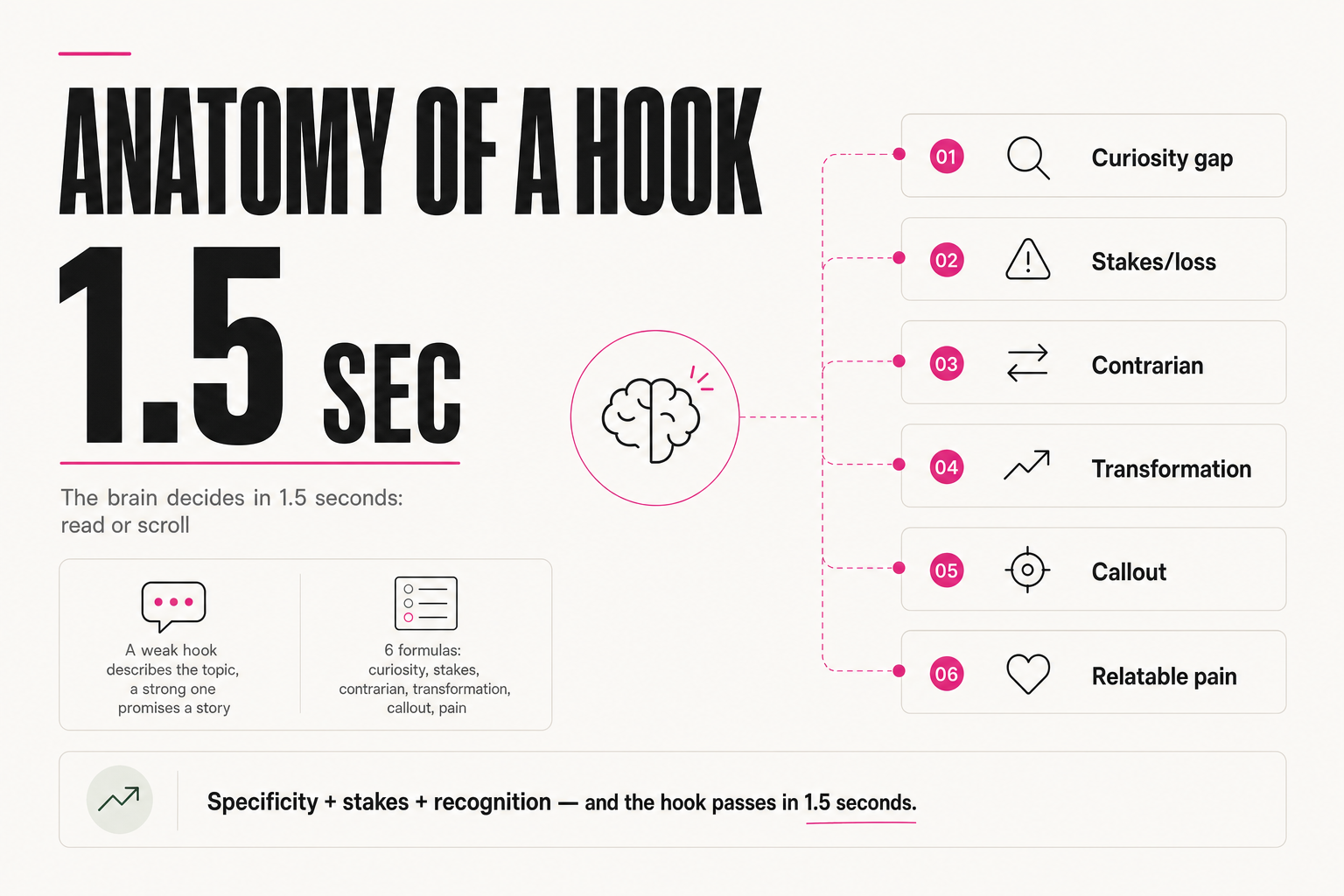
Part 1 - The hook: a short first post, 1-2 lines (about
         140-230 characters). Open with a CAPS label and a
         real person or quote ("I TOLD MY SISTER…",
         "BEFORE YOU…"), then one hard result, and end with
         "Here's how:" or "Here are the prompts:".
         No arrows, no emoji, no question in the first line.
         The content goes in the replies below it; a link,
         if you have one, only in the last reply.
Part 2 - Where it started: who, what was wrong, what it cost
Part 3 - What I tried first, and why it didn't work
Part 4 - Step 1 of what actually worked
Part 5 - Step 2
Part 6 - Step 3
Part 7 - The result, with a real number from your work
Part 8 - My opinion: what I'd tell you to do differently
Notice what's in it: a story only you can tell, steps someone can copy, and your opinion. That mix is what makes a stranger stop, save and follow.
03 - The method
How do you turn a voice memo into a long story with AI?
This is the part where most people say: "But I'm not a writer."
You don't need to be. Your part is the story and your opinion. AI turns your notes or a voice memo into the draft. Then a second pass, a critic, checks that every part is actually useful.
Go through it one step at a time:
Pick one real situation from your work this month. Talk for a few minutes, as if you were telling a friend: what happened, what you tried, what worked, what the result was, and what you think about it. Don't polish. Mistakes and pauses are fine; AI cleans them up.
Transcribe the memo (most phones and AI chats can do this) and paste it in with this prompt:
Here is a transcript of my voice memo about a real situation
from my work. Turn it into a Threads story of 6-8 posts:
- Post 1 is a hook: one short post of 1-2 lines (about
  140-230 characters). Open with a CAPS label and a real
  person or quote, like "I TOLD MY SISTER..." or
  "BEFORE YOU...", then one hard result, and end with
  "Here's how:" or "Here are the prompts:"
- No arrows, no emoji, no question in the first line
- The content goes in the replies; a link, if any, only
  in the last reply
- Then: where it started, what I tried first, the steps that
  worked, the result, and my opinion at the end
- Keep my words and my examples. Don't add facts, numbers
  or results I didn't say
- Short sentences. No hashtags. No "In today's world"
- Each post must make sense on its own and make people
  want the next one
Open a new chat, or ask the same one to switch roles. This is the step that removes the bland parts:
You are a strict editor. Read this Threads story post by post.
For each post, answer:
1. Would a stranger stop scrolling on the first line? If not,
   give me 3 sharper versions.
2. Is this post useful on its own, or is it filler?
3. Does anything sound generic, like it could be anyone's?
Then list the posts I should cut or merge. Don't rewrite
my story or invent details.
Read it out loud. If a line doesn't sound like you, change it. If a number isn't real, delete it. Then post it. The final "yes, that sounds like me" never goes to AI.
04 - The line
What stays yours, and what do you hand to AI?
AI multiplies what you bring. If you bring nothing, it multiplies nothing, and you get the same text as everyone else.
So I keep a clear line between my part and the AI's part:
Stays yours. Your opinion, your stories, your client results. Choosing topics you'd sign your name under. Replies to people, and their trust. The final "yes, that sounds like me".
Give to AI. Turning your memo into a draft. Rewriting a story that worked in other ways. Adapting it for each platform. Captions and the posting schedule.
Before you post, run through this list. It takes a minute and you can download it:
- It's a real situation from my work, not a general tip
- The first post makes a stranger curious in one line
- Someone could copy the steps without asking me
- Every number in it is real
- My opinion is in it, not only facts
- I read it out loud and it sounds like me
05 - The loop
What do you do with a story that worked?
Here's the part people skip: when a story works, they move on and start from zero again.
Don't. A post that worked on one platform has already proved the idea. You choose what to repeat. AI adapts it, a scheduler publishes it. With one channel, one algorithm decides your month. With several, a bad week on one doesn't stop the flow.
This Threads story did well with my audience: [paste it]
Adapt it, keeping my words and every fact as they are:
1. One Telegram or WhatsApp channel post (one message)
2. One LinkedIn post, a little more polished
3. 3 more hooks for the same story, for another day
Do not add numbers, results or examples I didn't write.
That's the whole loop: you live your work, you talk about it, AI does the drafting and the moving, and you say the final yes. No camera needed.
Your next step: pick one story from your work this month, talk about it into a voice memo for a few minutes today, and run it through the steps above.
06 - See it live
Where can you see the whole system live?
If you want to see this whole system live, Sofia, a launch producer, and I are running free live events in English.
Workshop · Wed 18 - Fri 20 Nov · 6 PM Dubai time
           (2 PM London, 9 AM New York)
Wed · Anjela and Sofia: build your business model and
      launch strategy in one evening
Thu · Anjela: the hook formulas behind a 794,649-view post,
      and the interactive guide that turns those views
      into followers
Fri · Sofia: why content gets applause but no sales, and
the event structure that turns viewers into buyersThe workshop is free. One registration covers all 3 evenings: sign up here →
FAQ
Do I need video to grow an audience?
No. I have over 750,000 followers and subscribers across 5 platforms (Nov 2026), about 78% of them on Threads, with $0 on ads. Video has its place, but if the camera is what stops you from posting, start with written stories.
What is a long story on Threads?
A chain of 6-8 posts about a real situation from your work: what happened, what you did step by step, the result with a real number, and your opinion. People save it and send it on.
I'm not a writer. Can AI write it for me?
AI writes the draft from your voice memo or notes. Your part is the story and your opinion. A second critic pass removes the bland parts, and you say the final yes.
How do I stop AI from making my text sound generic?
Give it your own material, tell it not to add facts or numbers you didn't say, run a strict critic pass on every post, and read the result out loud before you post.