Don't write the spec yourself. Ask the AI to interview you
A method that flips AI work upside down: instead of fighting a blank page, ChatGPT asks you questions one by one — and assembles the spec, guide or SOP from your answers.

01 — The pain
Why do "from your head" documents take hours?
Writing a spec used to mean sitting down for two or three hours to extract from my own head: what do I actually need here? What do I want?
Start with goals? Jump straight to requirements? And then you look at the text and think: "I don't even understand what I've written."
The problem isn't laziness or "bad writing skills." An expert's knowledge doesn't sit in the head as a finished document — it surfaces in response to questions. That's why explaining a task out loud is easy while writing it on a blank page is torture: the page doesn't ask questions.
02 — The flip
What changes when the AI asks and you answer?
The stupidly simple fix: stop trying to write the spec. Instead, ask ChatGPT to take you apart — with questions.
"Write a spec for project X." → The model produces a template spec off the internet with none of your actual requirements. You spend half an hour rewriting it and still miss things.
"Ask me questions about the project one at a time; anticipate everything a contractor would ask. I answer — you assemble the spec." → The model pulls the real requirements out of you, including ones you'd never have remembered.
Then the bot starts interviewing you: goals, audience, budget, deadlines. You just answer — like you're explaining it to a friend. I've done this about fifteen times now, and the main discovery: ChatGPT won't forget to ask what you usually miss. It knows which questions matter — it has seen thousands of these documents.
03 — The guide
How do you run the interview method start to finish?
Five steps, about fifteen minutes — and you have a document that used to eat half a day:
The method works for specs, checklists, guides, SOPs, onboarding docs, briefs. Take the document you've been putting off the longest — it's usually the one that unpacks best through questions.
Paste the prompt from the next section (or build your own in the generator). The key conditions inside: questions one at a time; anticipate everything the end user would ask; assemble the document from your answers, not from templates.
My hack: dictate your answers, transcribe, send. Out loud you answer three times more thoroughly and honestly than in writing. Don't edit yourself — the model needs details, not polish.
Around question five you'll want to say "okay enough, just assemble it." Hold on: the most valuable questions — edge cases and small nuances — come in the second half. Those are exactly what you "usually miss."
The model assembles the document from your answers. Check two things: everything important from the conversation made it in, and nothing was invented — if the model filled a gap itself, ask it to remove it or ask you a clarifying question instead.
04 — The prompt
What prompt starts the interview?
Here's the prompt — conversational, the way I actually send it:
Listen, I need to write a spec for a project. But instead of me struggling with it, how about you take me apart shelf by shelf? Ask me questions about the project and the task itself, don't skip the small nuances, anticipate every question a contractor might ask so we cover everything. I'll answer, and you'll assemble a proper spec out of it. Ask one question at a time; once you feel you have enough info, go ahead and write the spec. Deal?Now the main part: swap "spec" for any other document — the method works the same. Build your version:
And don't overcomplicate. Sometimes all it takes to make something great is asking the AI to simply ask you questions.
05 — Level up
How does interviewing digitize a whole expertise, not just one document?
One document is the warm-up. A series of interviews with the same method extracts the thing that's usually impossible to transfer: how an expert actually makes decisions.
A real example from my practice: the task was to reconstruct the algorithm for building a teaching schedule — the one living in specialists' heads. The goal of the interviews wasn't "invent automation" but to understand: what data they look at, in what order they check constraints, what they sacrifice in a conflict, how they negotiate changes. The series produced:
- a map of the current process — how decisions are really made;
- a complete list of input data;
- a reference of hard and soft constraints;
- priorities and rules for choosing between valid options;
- a list of exceptions — the things "everyone knows" that are written nowhere.
Ask the AI to interview you (or your specialist):
- "Walk me through your last real case: what did you look at
  first, and why?"
- "Which constraints can never be broken — and which can,
  if push comes to shove?"
- "What do you do when two rules contradict each other?"
- "Which exception cases do you keep in your head?"
- "What would break if a beginner with a manual replaced you?"
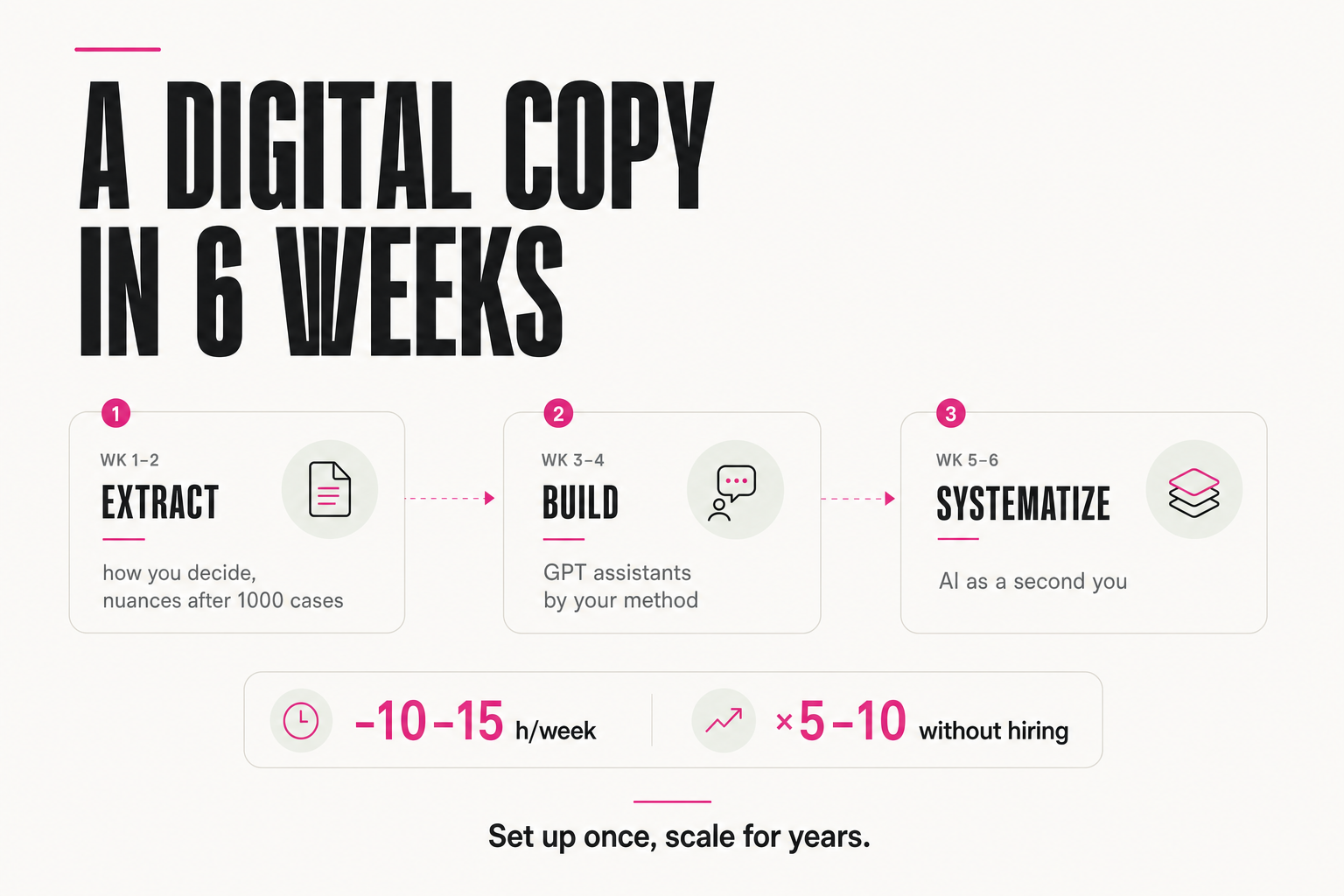
It's the same interview method — applied to experience instead of a document. And it's the first step toward your expertise working without you: the extracted algorithm becomes an assistant's instruction or the foundation of your digital copy.
06 — The limits
When does the interview method work — and when doesn't it?
The method isn't universal, and it's worth being honest about its limits. Check your task:
- The knowledge is in your head — you can answer questions, you just can't start from a blank page
- The output is a structured document: spec, SOP, guide, playbook, brief
- You're ready to answer at length (voice is ideal), not "yes/no"
- The document has a real user whose questions can be anticipated
- You'll finish the interview instead of cutting it off at question five
Ticked 4–5? The method is yours — start with the prompt in section 04. Fewer? The knowledge may not be in your head yet, and you need research first, not an interview: the AI can't extract what was never put in.
Stop writing documents from a blank page — they already exist in your head and just need to be pulled out by questions. The interviewer prompt does it in 15 minutes, and at the limit the same method digitizes an entire expertise. Start with the document you've been putting off the longest.
FAQ
Which documents does the interview method work for?
Specs, checklists, guides, SOPs, playbooks, briefs, onboarding docs — any structured document whose knowledge already lives in your head. Swap the word "spec" in the prompt for the document you need and the method works the same.
Why is answering out loud better than typing?
Out loud you answer far more thoroughly and naturally — like talking to a friend, with no inner editor. Dictate the answer, transcribe it with any tool, send it. The model doesn't need polished wording; it needs details — and voice answers always carry more of them.
How many questions is normal for one interview?
Usually 7–15. The key is not stopping early: the most valuable questions — about exceptions and small nuances — come in the second half, once the model understands the context. If it drags, say "ask all remaining questions as one list" and answer in one go.
What if the model assembles the document with invented details?
The prompt includes "nothing invented on your own," but verification is still on you: skim the document against what you actually said. If the model filled a gap itself, ask it to remove it or to ask you a clarifying question. That's a minute of work versus hours of writing from scratch.